Eight letters of Joseph (Lord) Lister to William Sharpey / by C. Robert Rudolf.
- Joseph Lister
- Date:
- 1933
Licence: In copyright
Credit: Eight letters of Joseph (Lord) Lister to William Sharpey / by C. Robert Rudolf. Source: Wellcome Collection.
4/30 page 2
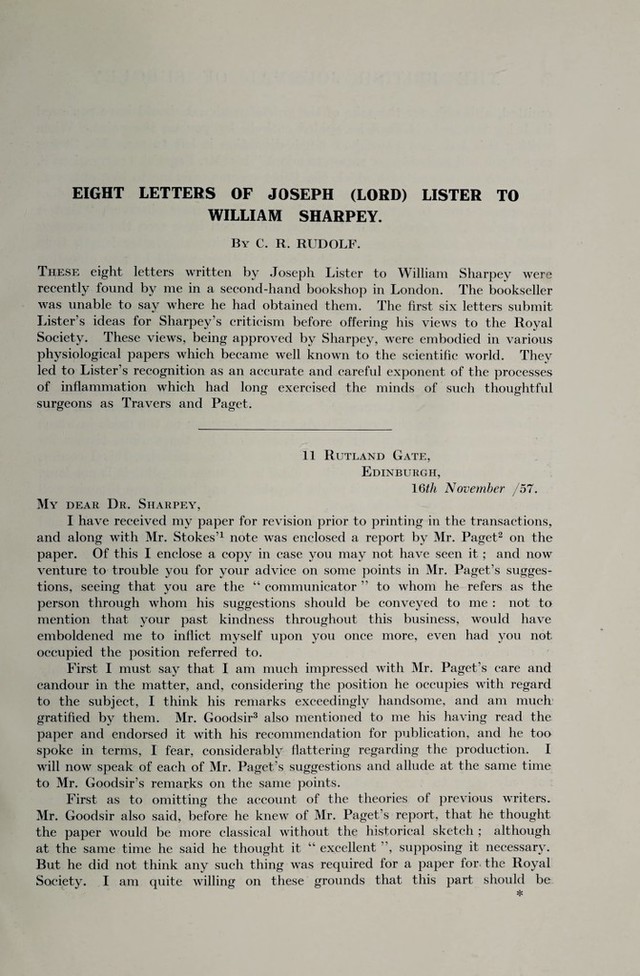
![omitted, although, for the sake of the general reader, I should have preferred its being retained. I shall be guided entirely by you on the point. When writing this I do not know how much discretion is left to me. Mr. Stokes says “ you will probably see reason to adopt ” his (Mr. Paget’s) “ suggestions ”. As to the second part which Mr. Paget recommends me to blot out, viz., the discussion of vital affinities, etc., in the second section, Mr. Goodsir does not appear quite to agree with Mr. Paget. The former observed, “ that is the opinion of a London man ”. Now, unless you have seen the paper you could hardly form a judgment without my writing at greater length than would be expedient ; but I would ask you if there would be any objection to my retaining the mention of the observation of the absolute stillness of the blood in the capillaries and veins between the pulses in small frogs under the influence of chloroform. The fact that this state of things may continue for an unlimited time without any accumulation of corpuscles occurring in the vessels appears to me important, as the heart, though exceedingly weak, is then obviously the only cause of the movement of the blood. I would very much curtail my remarks on the bearings of the observation. It is not only in Edinburgh that persons think the vital affinities a cause of the blood’s movement: witness Dr. Carpenter :4 and here the opinion is rampant that [the] said affinities are the chief cause ? As to the discussion on the mode in which the constituents of the liquor sanguinis required by the various tissues for the purpose of nutrition find their way out of the capillaries, this I confess is very hypothetical and I am quite willing to expunge it. But it is not long, and, if there be no objection, it might be printed, and then if you thought well I would strike it out of the proof. With regard to the expression about “ paralysing ” the concentrating and diffusing forces of the pigment cells, I feel seriously at a loss to know how to find a different mode of conveying my meaning. The facts are simply these. In the state of health the pigment cells exhibit the functions of concentration and diffusion of the granular portion of their contents under obedience to nervous influence. Also when a healthy limb is amputated concentration of the pigment (if previously diffused) takes place to the full degree and the pigment remains concentrated for some hours, after which a certain amount of diffusion again occurs, but if certain agents be applied to a portion of the web the pigment in that part ceases to manifest these functions. Not only is this the ease when the limb is in connection with the body, but also when severed from vascular and nervous connection with the trunk. If the agent be applied to part of a dark limb just amputated the post mortem concentra¬ tion does not occur in that part and again if the agent be applied when post mortem concentration is at the full, the subsequent diffusion does not take place in the spot operated on. In short, these functions of the pigment cells not only cease to vary in obedience to nervous influence, but also fail to exhibit the changes that ensue sooner or later after blood has ceased to circulate through the part : of which the post mortem concentration seems comparable to the post mortem rigidity of muscles. Now since I began to write this sentence I have been troubled with a difficulty that never occurred to me before, and which, I dare say, may be what Mr. Paget feels : and reflection upon this has detained this epistle two days. When speaking of](https://iiif.wellcomecollection.org/image/b30629408_0004.jp2/full/800%2C/0/default.jpg)