Volume 2
Illustrations of the Nueva quinologia of Pavon / by John Eliot Howard.
- Howard, J. Eliot (John Eliot), 1807-1883.
- Date:
- 1862
Licence: Public Domain Mark
Credit: Illustrations of the Nueva quinologia of Pavon / by John Eliot Howard. Source: Wellcome Collection.
17/242 page 3
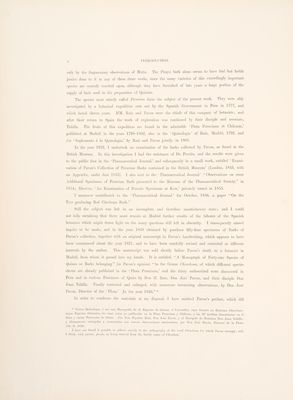
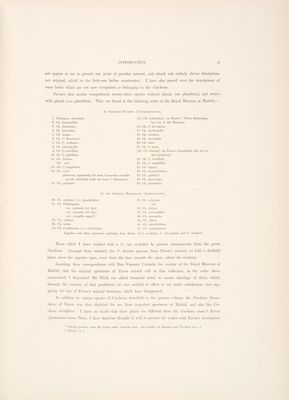
![not appear to me to present any point of peculiar interest, and struck out entirely eleven descriptions not original, added to the forty-one before enumerated. I have also passed over the descriptions of some barks which are not now recognized as belonging to the Cinchone. Pavon’s first section comprehends twenty-three species without glands (si glandulas), and twelve with glands (con glandulas). They are found in the following order in the Royal Museum at Madrid :— In Separate Packets. [UNscRoBIcuULatTE. | 1. Chinchona obtusifolia. [15. Ch. subcordata] (in Pavon’s ‘ Nueva Quinologia,’ 2. Ch. lucumeefolia. but not in the Museum). 3. Ch. dichotoma. 16, Ch. (7) ferrugines. 4. Ch. lanceolata. 17. Ch. erythrantha. do. Ch. stupea. 133Ch. coccmea. 6. Ch. (?) Tarontaron. 19. Ch. succirubra. 7. Ch. (?) Azaharito. 20. Ch. lutea. 8. Ch. microphylla. 21. Ch. (?) rosea. 9. Ch. (?) acutifolia. [22. Ch. obovata] (in Pavon’s description, but not in 10. Ch. (?) globiflora. the herbarium). 11. Ch. hirsuta. | 23. Ch. (?) viridifiora. Dor var. 24. Ch. (?) magnifolia. 12. Ch. (?) magniflora. 25. Ch. rugosa. 13. Ch. ovata. 26. Ch. decurrentifolia. pallescens (apparently the form Cascarilla crespilla 27. Ch. palalba.* grande, described under the head C. Pahudiana). 28. Ch. macrocalyx. 14. Ch. purpurea. 29. Ch. parabolica. In tHe GeneraL Herparium. [ScroBicuLare. | 30. Ch. undulata (¢.e. glandulifera). 35. Ch. suberosa. Ol. Ch. Chaharguera. var. var. (colorada del Rey.) 36. Ch. Palton. var. (amarilla del Rey.) 37. Ch. heterophylla. var. (crespilla negra ?) 38. Ch. micrantha. b2. Ch. violacea. 39. Ch. villosa. 33. Ch. nitida. 40. Ch. umbellulifera. 34, Ch. Condaminea (¢.e. Uritusinga). 41. Ch. conglomerata. Together with three specimens (probably from Mutis) of C. cordifolia, C. oblongifolia, and C. ovalifolia. Those which I have marked with a (?) are excluded by present arrangements from the genus Cinchona. Amongst those retained, the C. hirsuta appears, from Pavon’s account, to hold a doubtful place, since the capsules open, some from the base towards the apex, others the contrary. Learning, from correspondence with Don Vincente Cutanda, the curator of the Royal Museum at Madrid, that the original specimens of Pavon existed still in that collection, in the order above enumerated, [ dispatched Mr. Fitch, our ablest botanical artist, to secure drawings of these, which, through the courtesy of that gentleman, he was enabled to effect to my entire satisfaction, thus sup- plying the loss of Pavon’s original drawings, which have disappeared. In addition to various species of Cinchona described in the present volume, the Cimchona Zaron- taron of Pavon was thus sketched for me, from imperfect specimens at Madrid, and also the Cim- chona viridiflora. have no doubt that these plants are different from the Cinchona rosea,+ Pavon (Lasionema rosea, Don); I have therefore thought it well to present the reader with Pavon’s descriptions * Always palalba, from the Latin palus, Spanish palo; not pelalba, as Karsten and Weddell have it. # galustns 4p. 5.](https://iiif.wellcomecollection.org/image/b33544505_0002_0017.jp2/full/800%2C/0/default.jpg)
 No text description is available for this image
 No text description is available for this image
 No text description is available for this image