A valedictory address delivered before the medical class of the University of Vermont, May 31st, 1865 / by John Ordronaux.
- John Ordronaux
- Date:
- 1865
Licence: Public Domain Mark
Credit: A valedictory address delivered before the medical class of the University of Vermont, May 31st, 1865 / by John Ordronaux. Source: Wellcome Collection.
Provider: This material has been provided by The Royal College of Surgeons of England. The original may be consulted at The Royal College of Surgeons of England.
14/32 page 14
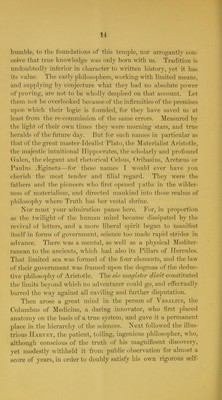
![humble, to the foundations of this temple, nor arrogantly con- ceive that true knoAvledge was only born with us. Tradition is undoubtedly inferior in character to written history, yet it has its value. The early philosophers, working with limited means, and supplying by conjecture what they had no absolute power of proving, are not to be wholly despised on that account. Let them not be overlooked because of the infirmities of the premises u]ion which their logic is founded, for they have saved us at least from the re-commission of the same errors. Measured by the light of their own times they were morning stars, and true heralds of the future day. But for such names in particular as that of the great master-Idealist Plato, the Materialist Aristotle, the majestic intuitional Hippocrates, the scholarly and profound Galen, the elegant and rhetorical Celsus, Oribasius, Aretfeus or Paulus j^lgineta—for these names I would ever have you cherish the most tender and filial regard. They were the fathers and the pioneers who first opened paths in the wilder- ness of matei'ialism, and directed mankind into those realms of pliilosophy where Truth has her vestal shrine. Nor must your admiration j)ause here. For, in proportion as the twilight of the human mind became dissipated by the revival of letters, and a more liberal spirit began to manifest itself in tonus of government, science too made rapid strides in advance. There was a mental, as well as a physical Mediter- ranean to the ancients, which had also its Pillars of Hercules. That limited sea was formed of the four elements, and the law of their government was framed upon the dogmas of the deduc- tive philosophy of Aristotle. The sic magister dixit constituted the limits beyond which no adventurer coidd go, and effectually barred the way against all caviling and fiu-ther disputation. Then arose a great mind in the person of Vesalius, the Columbus of Medicine, a daring innovator, who fii-st placed anatomy on the basis of a true system, and gave it a permanent place in the hierarchy of the sciences. IS'ext followed the illus- trious Harvey, the patient, toiling, ingenious philosopher, who, although conscious of the truth of his magnificent discovery, yet modestly withheld it from public observation for almost a score of years, in order to doubly satisfy his own rigorous self-](https://iiif.wellcomecollection.org/image/b22304137_0016.jp2/full/800%2C/0/default.jpg)