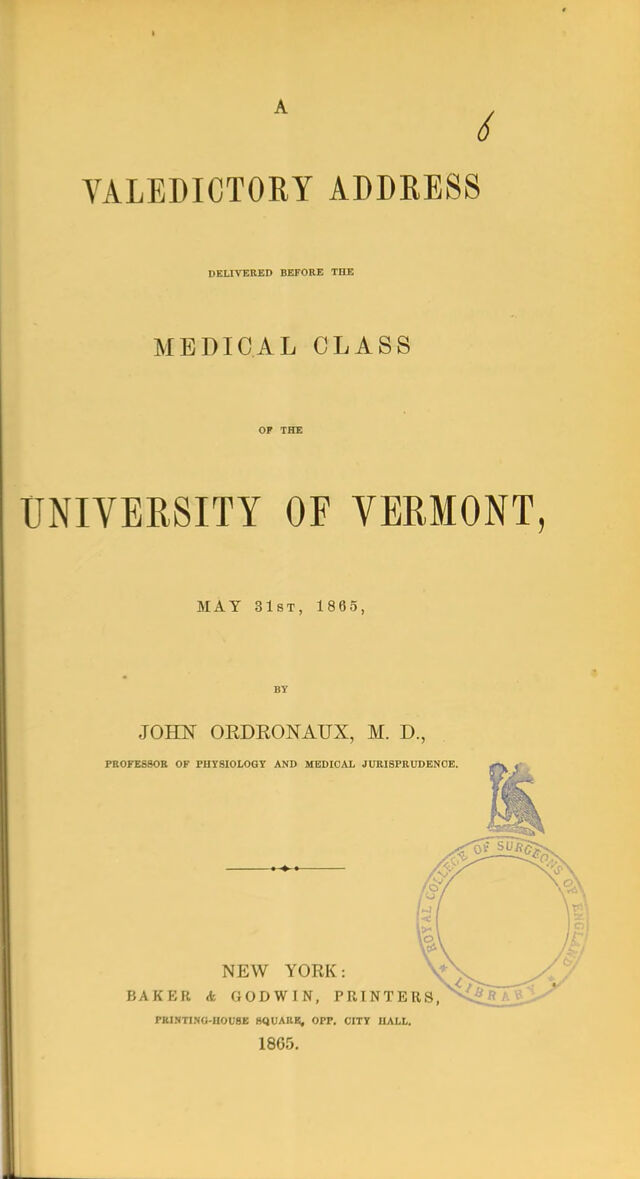
A valedictory address delivered before the medical class of the University of Vermont, May 31st, 1865 / by John Ordronaux.
- John Ordronaux
- Date:
- 1865
Licence: Public Domain Mark
Credit: A valedictory address delivered before the medical class of the University of Vermont, May 31st, 1865 / by John Ordronaux. Source: Wellcome Collection.
Provider: This material has been provided by The Royal College of Surgeons of England. The original may be consulted at The Royal College of Surgeons of England.
4/32 page 4
![and support of a common brotherhood. Yet, ere you cross this sacred thi-eshold, I pray you to pause in dee])est reflection, tliat, moved as well by a spirit of introspection and self-examination, as of historical remembrance, you may enter her tabernacle with mute thanks and secret ecstasy; draw the curtain from before the veiled Deity, with a pure and tender hand; and gaze upon that ancient sln-ine at which every tribe and nation, savage or sage have successively bowed, with humility, and awe-inspu'ing reverence. Here are the votive tablets; here the inscriptions of praise hymned by grateful suppliants who touched her altars, were healed, and went tlieir way rejoicing. From this treasmy of natm*al laws, Jewish and Egyptian liigli- priests, Greek hierophants, Roman pontifi's, Saracen and Bud- dhist pundits drew inspiration, prescribed laws for tlie moral government of mankind, and obtained healing agents for the mind or body of suffering mortals. Even the Fathers of the Chm'ch have been patient investigators within these walls, and have largely incorporated into theii* writings the laws of our physical nature as a system, whose knowledge would afford the best means of protection against the temptations of the flesh, and while preserving the health of the body would greatly conduce to that of the spirit; and in particular St. Clement, of Alexandria,* has left us, in the second part of his Pedagogus, a complete treatise on Hygiene, plainly exhibiting his acquaint- ance with that science into whose temple you are about enter- ing as newly ordained members of her priesthood. Behold too her history! It is as ancient as that of the ages, and is written in imperishable characters in the records of our race. Behold her triumphs founded ever in humanity and brotherly love. Behold her principles resting upon the eternal and im- mutable laws of nature, and in their legitimate orthodox appli- cation to practice, speculating never upon the credulity of the weak or the ignorant, but acting in obedience to the deductions of widely-spread analogies, and supported by the unquestioned evidence of centuries of experience. These are the foundations on which rest the canons of her practice ; these the boundary * Titus Flaviu3 Clemens St. Ojp.Omnife, ed. Basil, 1856, pp. 20-30.](https://iiif.wellcomecollection.org/image/b22304137_0006.jp2/full/800%2C/0/default.jpg)