J.H. van Linschoten his discours of voyages into ye East and West Indies, in foure bookes / [Translated by William Phillip].
- Jan Huyghen van Linschoten
- Date:
- 1598
Licence: Public Domain Mark
Credit: J.H. van Linschoten his discours of voyages into ye East and West Indies, in foure bookes / [Translated by William Phillip]. Source: Wellcome Collection.
292/482 page 268
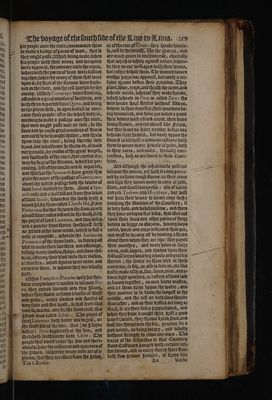
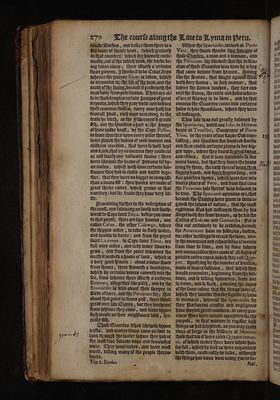
![and twenty Italian miles: the coaſt is low and ful of vallies, and thereabouts runneth rertaine riuers into the ſea, which inwards to the land are inhabited: from thence the toaſt runneth ſouthweſt to the ſtrand called S. Iacob, 0: S. Iago, and maketh a greate Crake, where there is an open hauen oz roade named by the Sardinians: and from thence runneth the great riuer ol S. Iacob, where the gouernement of Pizarro began: and this ſtrand is 9, miles + from the point of Maoglares, and it happeneth many times that the ſhips haue there at the beake head fourefco2e fadomes water, and at the fterne they touch the ground : and allo it is often found, that ſometimes they faple in two far domes water, and pꝛeſently they find nine⸗ tie ladomes, which the ſtrong courſe and fury of the riuer tauſeth:and although there are ſuch banks, yet are they not dangerous, neither do the ſhippes refule to pale in and thew, in dur Carde Mathias, lyeth full in one degree: from thence the cdaſt runneth weft to the Cape faint Francis, which lieth fromthe ſtrand thirtie Italian miles, that is, feuen Spaniſh miles and one halfe:this poynt lieth on high ground, and hard by it are cerfapne red and white Downes, that are of the ſame height. This poynt offaint Francis lyeth vnder one degrer, on the noꝛth fide of the Cquinoctiall line. From thence the coat runneth ſouthwealt, to the popnt Paſſao, which is the fir hauen of Peru, o⸗ uer the which palleth the Cquinociall line. Betweene theſe two poynts there runneth foure great riuers into the Sea, which are called Liquixinus, in Latine Quiſnuæ, and there about there is an indifferent god Baz uen, where the hips finde god water and wod to burne. From the poynt Paſſao, to the firme land are diuers high hilles, that are called De Quaque : the popnt is a land which is not duer lowe, where pou & cers fapne Dobones as alozeſaide. Here followeth the Nauigation from the Line to the Towne ef the Kings called Lyma, Fkomhentee fozwarde wee haue declared the coaſt of Panama, in the South ſea, til you come to the hanen of Quixinus, which lieth in the Countrey of Peru, now 4 will gor foꝛward with the courle that lieth bee tweene Quixinus and the tone ol Rings, The 2. Book e. ‘ tb then departing from the poynt de Paſſos the coak ſtretcheth ſouth, and ſouth and by Wall, tu the hauen called Porto veio, oꝛ the Old Bauen: and before vou come thither, there lieth the ſtrand called Charaqui, her the Hips may put in without any daunger, and it is fo fate a ſtrand that they may there lay their ſhips on ſhoare, and mend them ik they neede, be they neuer fo great, foꝛ it is a god hauen ofentraunce , onelp that in the midle ol the entry there lieth certain ones oꝛ rugged Iſlands, but the ſhippes may ene ter at which fide they wil and palſe by them without any danger, fo2 there is nothing to be ſhunned, but onely that which pou fee beloꝛe pour eyes, the Olde Hauen lieth vn⸗ der ane Begree on the fouth fide of the Equi notttall line, and is one ofthe fiue Townes which the cheiftians oꝛ Spaniardes haue built in the flat land of Peru, fo that Porto Veio fignifieth the fone and countrep ip: ing thereabouts, which is much ouerrunne t walked betauſe it is a pꝛe vnwholeſome country, vet it bath certain mines ol Sma⸗ ragdes, which they held long time hidden, and by no meanes would diſcouer them, as to this dap they vet do. They had likewile in times pall many golde and filucr veſlels which are by the Spaniardes all taken and carried away, but now by the kings letters patents being made free, they pap to theyꝛ all their fruits, whereby many Spaniards withdꝛawe themſelues from thence, ſceing their pꝛofite to decay. The Countrey about birdes neſts, and becaule the coat is mo⸗ rich, there is no being ſoꝛ hoꝛſes, where⸗ by it was not ſo lone ſubdued by the Spa⸗ niardes, as alſo becauſe that out of theyz neſts, they thꝛew ſtones, iauelines, pottes with hot water, and whatfoener came next to hand, whereby they killed many S pants ards, wherewith they were foꝛted to teuer themſelues with boꝛdes, and fo cut dewne the tres, befoze they could ouertome them. tharpe, and wilde, that they could hardelp finde pꝛouiſion fo2 their army: there is pet much country thereabouts vnhabited. By the Old Hauen two miles within the land is the towne offaint lacob, 92 lao, which fo2 houſes and inhabitants is not infcrisur fage of Gainacaua,by the Spaniards fo cals led fo2 this occafion, that Gainacaua the faz ther of Attabalida vpon acertain time lent one ok his Captaines, with a great army to ſubdue that countrex, who minding to 915 f ig — ——— — — - 4) ye poate i i pote ger 4 together tpi wind ant une withthe inte cane Hiding that nee der chen ö oa and {yt une daun, aut the placed hatte faintla A onihmnt flat ey Porto v imo thepayt Ada an en lein. Perun god to Hang: deen of 1 dine cared in pyar Chen Lee cor Ht, they lech — Uy eit And. lant, Be fay etch dt, | Okt i Pig he]](https://iiif.wellcomecollection.org/image/b30333118_0292.jp2/full/800%2C/0/default.jpg)