A handbook of diseases of the eye and their treatment / by Henry R. Swanzy.
- Swanzy, Henry R. (Henry Rosborough), 1843-1913
- Date:
- 1895
Licence: Public Domain Mark
Credit: A handbook of diseases of the eye and their treatment / by Henry R. Swanzy. Source: Wellcome Collection.
Provider: This material has been provided by UCL Library Services. The original may be consulted at UCL (University College London)
38/632 page 14
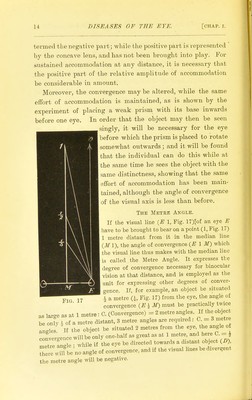
![tei'med the negative part; while the positive part is represented by the concave lens, and has not been brought into play. For sustained accommodation at any distance, it is necessary that the positive part of the relative amplitude of accommodation be considerable in amount. Moreover, the convergence may be altered, while the same effort of accommodation is maintained, as is shown by the experiment of placing a weak prism with its base inwards before one eye. In order that the object may then be seen singly, it will be necessary for the eye ] before which the prism is placed to rotate somewhat outwards; and it will be found ] that the individual can do this while at the same time he sees the object with the same distinctness, showing that the same effort of accommodation has been main- tained, although the angle of convergence 1 of the visual axis is less than before. The Metke Angle. If the visual line {E 1, Fig. 17)[of an eye E I have to be brought to bear on a point (1, Fig. 17) 1 metre distant from it in the median line (i)/l), the angle of convergence {E \ M) which the visual line thus makes with the median line is called the Metre Angle. It expresses the degree of convergence necessary for binocular vision at that distance, and is employed as the I unit for expressing other degrees of conver- gence. If, for example, an object be situated 1 a metre (-i, Fig. 17) from the eye, the angle of convergence {E ^ M) must be practically twice as large as at 1 metre: C. (Convergence) = 2 metre angles. If the object be only i of a metre distant, 3 metre angles are reqmred : C = 3 met.e angles If the object be situated 2 metres from the eye the angle of convergence will be only one-half as great as at 1 metr;e, and here C. = ^ metre angle ; while if the eye be directed towards a distant object (i?) U.eSbe no angle of convergence, and if the visual lines be divergent the metre angle will be negative.](https://iiif.wellcomecollection.org/image/b21641250_0038.jp2/full/800%2C/0/default.jpg)