A handbook of diseases of the eye and their treatment / by Henry R. Swanzy.
- Swanzy, Henry R. (Henry Rosborough), 1843-1913
- Date:
- 1895
Licence: Public Domain Mark
Credit: A handbook of diseases of the eye and their treatment / by Henry R. Swanzy. Source: Wellcome Collection.
Provider: This material has been provided by UCL Library Services. The original may be consulted at UCL (University College London)
54/632 page 30
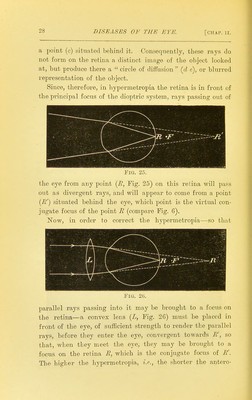
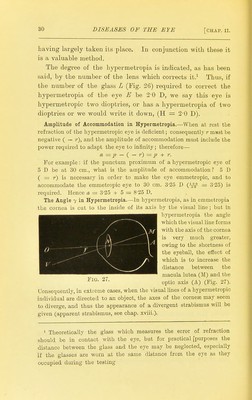
![having largely taken its place. In conjunction with these it is a valuable method. The degree of the hypermetropia is indicated, as has been said, by the number of the lens which corrects it.^ Thus, if the number of the glass L (Fig. 26) required to correct the hypermetropia of the eye E be 2'0 D, we say this eye is hypermetropic two dioptrics, or has a hypermetropia of two dioptries or we would write it down, (H = 2-0 D). Amplitude of Accommodation in Hypermetropia.—When at rest the refraction of the hypermetropic eye is deficient; consequently r nmst be negative ( — ?•), and the amplitude of accommodation must include the power required to adapt the eye to infinity; therefore— a =]> — {— r) =1) + r. For example : if the punclum proximum of a hypermetropic eye of 5 D be at 30 cm., what is the amplitude of accommodation? 5 D ( = r) is necessary in order to make the eye emmetropic, and to accommodate the emmetropic eye to 30 cm. 3'25 D (yyi = 3-25) is required. Hence a = 3'25 + 5 = 8-25 D. The Angle y in Hypermetropia.—In hypermetropia, as in emmetropia the cornea is cut to the inside of its axis by the visual line; but in hypermetropia the angle which the visual line forms with the axis of the cornea is very much greater, owing to the shortness of the eyeball, the eifect of which is to increase the distance between the macula lutea (M) and the optic axis (A) (Fig. 27). Consequently, in extreme cases, when the visual lines of a hypermetropic individual are directed to an object, the axes of the cornese may seem to diverge, and thus the appearance of a divergent strabismus will be given (apparent strabismus, see chap, xviii.). ' Theoretically the glass which measures the error of refraction should be in contact with the eye, but for practical [purposes the distance between the glass and the eye may be neglected, especially if the glasses are worn at the same distance from the eye as they occupied during the testing](https://iiif.wellcomecollection.org/image/b21641250_0054.jp2/full/800%2C/0/default.jpg)