Volume 1
Diseases of the organs of respiration : a treatise on the etiology, pathology, symptoms, diagnosis, prognosis, and treatment of diseases of the lungs and air-passages / by Samuel West.
- Samuel West
- Date:
- 1909
Licence: Attribution-NonCommercial 4.0 International (CC BY-NC 4.0)
Credit: Diseases of the organs of respiration : a treatise on the etiology, pathology, symptoms, diagnosis, prognosis, and treatment of diseases of the lungs and air-passages / by Samuel West. Source: Wellcome Collection.
Provider: This material has been provided by The University of Leeds Library. The original may be consulted at The University of Leeds Library.
414/450 (page 380)
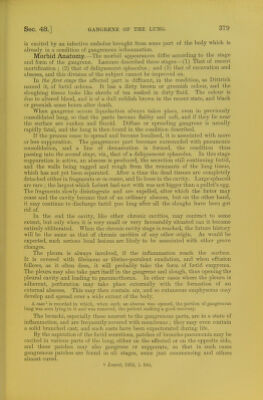
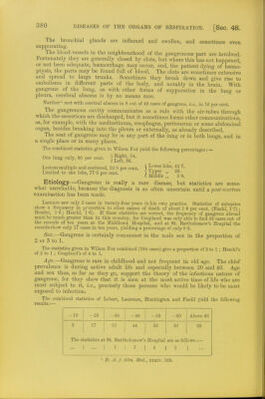
![The bronchial glands are inflamed and swollen, and sometimes even suppurating. The blood-vessels in the neighbourhood of the gangrenous part are involved. Fortunately they are generally closed by clots, but where this has not happened] or not been adequate, hsemorrhage may occur, and, the patient dying of hsemo- ptysis, the parts may be found full of blood. The clots are sometimes extensive and spread to large trunks. Sometimes they break down and give rise to embolisms in different parts of the body, and notably in the brain. With gangrene of the lung, as with other forms of suppuration in the lung or pleura, cerebral abscess is by no means rare. Nartlieri met with cerebral abscess in 8 out of 49 cases of gangrene, i.e., in 16 per cent. The gangrenous cavity communicates as a rule with the air-tubes through -which the secretions are discharged, but it sometimes forms other communications, as, for example, with the mediastinum, oesophagus, peritoneum or some abdominal organ, besides breaking into the pleura or externally, as already described. The seat of gangrene may be in any part of the limg or in both lungs, and in a single place or in many places. The combined statistics given in Wilson Fox yield the following percentages:— Right, 54. I Lower lobe, 42 -7. < Upper „ 29. ( Middle „ 5-8. Etiology.—Gangrene is really a rare disease, but statistics are some- what unreliable, because the diagnosis is so often uncertain until a post-viortem examination has been made. Laennec saw only 2 cases in twenty-four years in his own practice. Statistics of autopsies show a frequency in proportion to other causes of death of about 1-6 per cent. (Fischl, 1-7) ; Boudet, 1-6 ; Heschl, 1-6). If these statistics are correct, the frequency of gangrene abroad must be much greater than in this country, for Coupland was only able to find 38 cases out of the records of ten years at the Middlesex Hospital, and at St. Bartholomew's Hospital the ' records show only 17 cases in ten years, yielding a percentage of only 0-3. Sex.—Gangrene is certainly commoner in the male sex in the proportion of 2 or 3 to 1. The statistics given in Wilson Fox combined (184 cases) give a proportion of 3 to 1 : Heschl's of 2 to 1 ; Coupland's of 4 to 1. Age.—Gangrene is rare in childhood and not frequent in old age. The chief prevalence is during active adult life and especially between 20 and 40. Age and sex thus, so far as they go, support the theory of the infectious nature of gangrene, for they show that it is men at the most active time of life who are most subject to it, i.e., precisely those persons who would be likely to be most exposed to infection. The combined statistics of Lebert, Laurence, Huntington and Fischl yield the following results:— One lung only, 90 per cent, j j^^jj. gg Lesions multiple and scattered, 22-5 per cent. Limited to one lobe, 77 5 per cent. -10 -20 -30 -40 -50 -60 Above 60 3 The s 17 :atistics a ... 51 t St. Bart] ■ 1 44 lolomew's 7 1 35 Hospital 5 31 are as fol 1 22 ows :— 1 - ' D. A./, klin. Med., xxxiv. 169.](https://iiif.wellcomecollection.org/image/b21518956_0001_0414.jp2/full/800%2C/0/default.jpg)