Clinical psychiatry : a textbook for students and physicians, abstracted and adapted from the 6th German edition of Kraepelin's "Lehrbuch der psychiatrie" / by A. Ross. Diefendorf.
- Emil Kraepelin
- Date:
- 1904
Licence: Public Domain Mark
Credit: Clinical psychiatry : a textbook for students and physicians, abstracted and adapted from the 6th German edition of Kraepelin's "Lehrbuch der psychiatrie" / by A. Ross. Diefendorf. Source: Wellcome Collection.
Provider: This material has been provided by the Harvey Cushing/John Hay Whitney Medical Library at Yale University, through the Medical Heritage Library. The original may be consulted at the Harvey Cushing/John Hay Whitney Medical Library at Yale University.
43/478 (page 27)
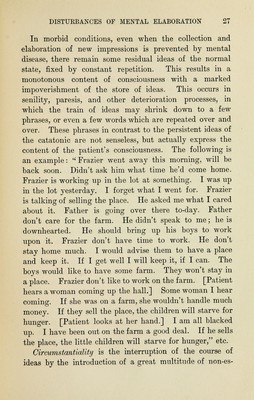
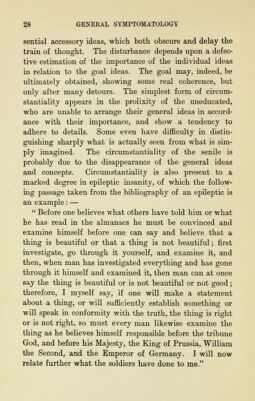
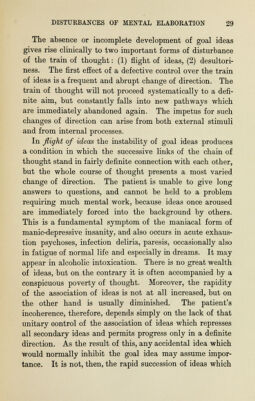
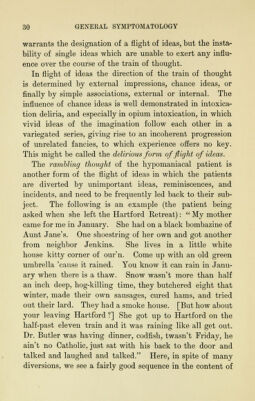
![In morbid conditions, even when the collection and elaboration of new impressions is prevented by mental disease, there remain some residual ideas of the normal state, fixed by constant repetition. This results in a monotonous content of consciousness with a marked impoverishment of the store of ideas. This occurs in senility, paresis, and other deterioration processes, in which the train of ideas may shrink down to a few phrases, or even a few words which are repeated over and over. These phrases in contrast to the persistent ideas of the catatonic are not senseless, but actually express the content of the patient's consciousness. The following is an example: Frazier went away this morning, will be back soon. Didn't ask him what time he'd come home. Frazier is working up in the lot at something. I was up in the lot yesterday. I forget what I went for. Frazier is talking of selling the place. He asked me what I cared about it. Father is going over there to-day. Father don't care for the farm. He didn't speak to me; he is downhearted. He should bring up his boys to work upon it. Frazier don't have time to work. He don't stay home much. I would advise them to have a place and keep it. If I get well I will keep it, if I can. The boys would like to have some farm. They won't stay in a place. Frazier don't like to work on the farm. [Patient hears a woman coming up the hall.] Some woman I hear coming. If she was on a farm, she wouldn't handle much money. If they sell the place, the children will starve for hunger. [Patient looks at her hand.] I am all blacked up. I have been out on the farm a good deal. If he sells the place, the little children will starve for hunger, etc. Circumstantiality is the interruption of the course of ideas by the introduction of a great multitude of non-es-](https://iiif.wellcomecollection.org/image/b21017244_0043.jp2/full/800%2C/0/default.jpg)