Description of the models of hospitals / J.J. Woodward.
- Army Medical Department
- Date:
- 1876
Licence: Public Domain Mark
Credit: Description of the models of hospitals / J.J. Woodward. Source: Wellcome Collection.
Provider: This material has been provided by The Royal College of Surgeons of England. The original may be consulted at The Royal College of Surgeons of England.
35/40 page 21
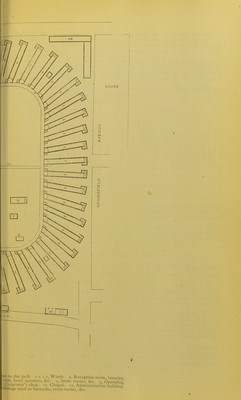
![Thu apparatus for mbduing fire consists of 2000 feet of 2J-incli iudia-rubbei: liusu, with coupliugs comijlcto, 8 lire-plugs, and one rt-borse power force pnmp. Two large ro«crvo tanks, holding ;;(),(:(;() gallouy of water, are placed over the main corridor, on brick walls, for the purpose! of furnishing an extra amount of water shonld the supply from the main he insuflicient. In addition to the above, each ward has a 20-foot section of inch hose, with coup- hugs and branch pipe, th-it can bo attached in a moment to a small plug in the water-closet. Each v/nrd has also in the dining-room a hre-axe, and three lire-buc!:- cts kept constantly filled. It has been stated before that an organized fire-guard patrols the hospital at night. This hospital v.-as opened March 12, 18G;5, and closed July 30, 18G5. During tills period the movements of patients were us follows: Admitted. I and Results. Sick. Wounded. Total. Returned from furlough desertion. 1 M < 0 < 1 Returned to duty. Mu.stered out. Sent to other general hospital. Furloughed. Transferred to Veteran Reserve Corps. Discharged. Deserted. Died of disease. Died of Wounds. White troops (Colored troops 3382 34 4 7533 38 25 39 1 10652 ! Si 3395 35 8 720 '738 I 3192 Ill 698 2 691 7 36 Prisoners of War 25 8 9 Total 3416 4180 7596 3119 i 1 107'5 j 3438 720 174S 3193 700 . 691 in 71 44 Deducting those sent to other hospitals as cases not terminated, and considering that the furloughed and deserted amounted to 3883, while only 311'.) of these are reported as having returned, we shall have the following statistics for the terminated cases of icMte troops treated : Tot.il to be accounted for, excluding those sent to other hospitals, r)7'J5 ; of whom 33',)r. were returned to duty, 720 were mustered out of service at the close of the war, 704 lost by failure to return from furlough and desertion, (i'JS discharged for. disabihty. 111 transferred to the Veteran Reserve Corps, and 107 died. 5.—Model of the Mower Hospital, Philadelphia, Pa. This is a block-model on the scale of 30 feet to the inch. The follow- ing description is condensed from an inspection report by Medical Inspector John L. Le Coute, U. S. A.: The Mower Hospital is situated on an elevated plateau in the village of Chestnut Hi 1, about!) miles north of ihe city of Philadelphia. It is on the eastern side of the raih-o.id, and trams from' Thiladelphia pass every two hours. The total capacity of the hospital is 3(;0() l)eds. ^ It is constructed of wood in the best manner, lined with smooth planks on the in side, and lathed and plastered on the outside. It consists of r,0 pamlions, radiatiuc from a eorndor of a re:;t uignlar form, witli rounded aut^les. The corridor is l(i feet wide and 24()() feet long, enclosing a space of 7 ticras. The Adnimulration Buiklinq iH located m the centre of the enclosed space. This building is connected with the words by a t.ransver.so coiTidor. (See Pig. 1].) ^I'li fUL 1](https://iiif.wellcomecollection.org/image/b22280558_0035.jp2/full/800%2C/0/default.jpg)