The essentials of practical bacteriology : an elementary laboratory book for students and practitioners / by H. J. Curtis.
- Curtis, Henry J.
- Date:
- 1900
Licence: In copyright
Credit: The essentials of practical bacteriology : an elementary laboratory book for students and practitioners / by H. J. Curtis. Source: Wellcome Collection.
Provider: This material has been provided by The University of Leeds Library. The original may be consulted at The University of Leeds Library.
217/314 (page 199)
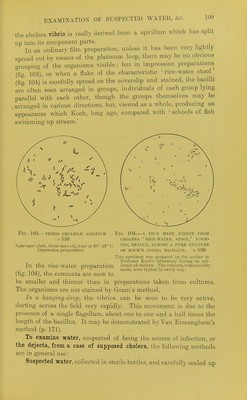
![EXAMINATION OF SUSPECTED WATEK, &c. the cholera vibrio is really derived from a spirillum which has spHt lip into its component parts. In an ordinary film preparation, unless it has been very hghtiy spread out by means of the platinum loop, there may be no obvious grouping of the organisms visible; but in impression preparations (fig. 103), or when a flake of the characteristic ' rice-water stool' (fig. 104) is carefully spread on the coverslip and stained, the bacilli are often seen arranged in groups, individuals of each group lying parallel with each other, though the groups themselves may be arranged in various directions, but, viewed as a whole, producing an appearance which Koch, long ago, compared with ' schools of fish swimming up stream.' Fig. 103.- FlG. 104.—A FILM MADE DERECT FROM CHOLEEA ' EICE-WATEB. STOOL,' FOHM- ' Agar-agar plate, three days old, kept at 20^-22° C. REALLY, ALMOST A PUBE CULTUBE VIBEIO CHOLEB.E ASIATICS x530 Impression preparation. OF koch's comma bacillus. X 530 This specimen was prepared by the author in Professor Koch's laboratory dnring an epi- In the rice-water preparation Jemlc of cholera. The cultures, subsequently ■ made, were typical in every way. (fig. 104), the commata are seen to be smaller and thinner than in preparations taken from cultures. The organisms are not stained by Gram's method. In a hanging-dro]), the vibrios can be seen to be very active, darting across the field very rapidly. This movement is due to the presence of a single flagellum, about one to one and a half times the length of the bacillus. It may be demonstrated by Van Ermenghem's method (p. 171). To examine water, suspected of being the source of infection, or the dejecta, from a case of supposed cholera, the following methods are in general use : Suspected water, collected in sterile bottles, and carefully sealed up](https://iiif.wellcomecollection.org/image/b21503035_0219.jp2/full/800%2C/0/default.jpg)