The essentials of practical bacteriology : an elementary laboratory book for students and practitioners / by H. J. Curtis.
- Curtis, Henry J.
- Date:
- 1900
Licence: In copyright
Credit: The essentials of practical bacteriology : an elementary laboratory book for students and practitioners / by H. J. Curtis. Source: Wellcome Collection.
Provider: This material has been provided by The University of Leeds Library. The original may be consulted at The University of Leeds Library.
83/314 (page 65)
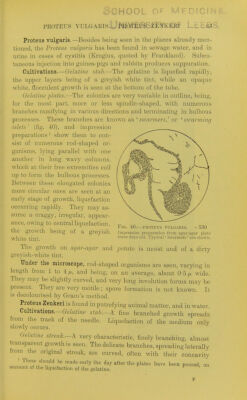
!['vHOuL v.- MEDICfi PROTEUS VULGARIS. ,' priOTE0~£Si:l^<:]iiJi^ Proteus vulgaris.—Besides being seen in the places already men- tioned, the Proteus vulgaris has been found in sewage water, and in urine in cases of cystitis (Krogius, quoted by Frankland). Subcu- taneous injection into guinea-pigs and rabbits produces suppuration. Cultivations. — Gelatine stab.—The gelatine is liquefied rapidly, the upper layers being of a greyish white tint, while an opaque white, flocculent growth is seen at the bottom of the tube. Gelatine plates.—The colonies are very variable in outline, being, for the most part, more or less spindle-shaped, with numerous branches ramifying in various directions and terminating in bulbous processes. These branches are known as ' sioarmers' or ' sioarming islets ' (lig. 40), and impression prepai'ations ' show them to con- sist of numerous rod-shaped or- ganisms, lying parallel with one another in long wavy columns, which at their free extremities coil up to form the bulbous processes. Between these elongated colonies more chcular ones are seen at an early stage of growth, liquefaction occurring rapidly. They may as- sume a craggy, irregular, appear- ance, owing to central hquefaction, the growth being of a greyish white tint. The growth on agar-agar and j^otato is moist and of a dirty greyish-white tint. Under the microscope, rod-shaped organisms are seen, varying in length from 1 to 4/i, and being, on an average, about 0-5 wide. They may be slightly curved, and very long involution forms may be present. They are very motile; spore formation is not known. It is decolourised by Gram's method. Proteus Zenkeri is found in putrefying animal matter, and in water. Cultivations.—GeZa^me stab.~k fine branched growth spreads from the track of the needle. Liquefaction of the medium only slowly occurs. Gelatine streak.—A very characteristic, finely branching, almost transparent growth is seen. Thedehcate branches, spreading laterally from the original streak, are curved, often with their concavity ' n^ade early the day after the plates have been poured, account of the liquefaction of the gelatine. -PKOTEtIS VULGAKIS. X 530 Impression preparation from agar-agar plate tliree days old. Typical ' swr.rmers' are shown. on](https://iiif.wellcomecollection.org/image/b21503035_0085.jp2/full/800%2C/0/default.jpg)