Trench "frost-bite" : some observations on cases admitted to the Duchess of Westminster's War Hospital / by C. Gordon Watson and Charles S. Myers.
- Watson, C. Gordon.
- Date:
- 1915
Licence: In copyright
Credit: Trench "frost-bite" : some observations on cases admitted to the Duchess of Westminster's War Hospital / by C. Gordon Watson and Charles S. Myers. Source: Wellcome Collection.
3/16
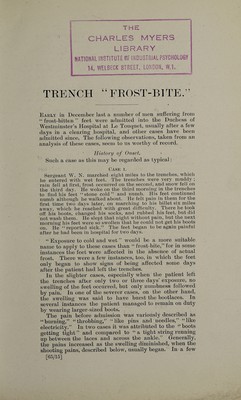
![THE CHARLES MYERS LIBRARY NATIONAL INSTITUTE 8F INDUSTRIAL PSYCHOLOGY 14, WEIBECK STREET. LONDON, W.l. TRENCH “FROST-BITE.” I J ;( Early in December last a number of men suffering from “ frost-bitten ” feet were admitted into the Ducliess of Westminster’s Hospital at Le Touquet, usually after a few days in a clearing hospital, and other cases have been admitted since. The following observations, taken from an analysis of these cases, seem to us worthy of record. ’ History of Onset. Such a case as this may be regarded as typical: Case i. Sergeant W. N. marched eight miles to the trenches, which he entered with wet feet. The trenches were very muddy ; rain fell at first, frost occurred on the second, and snow fell on the third day. He woke on the third morning in the trenches to find his feet “stone cold” and numb. His feet continued numb although he walked about. He felt pain in them for the first time two days later, on marching to his billet six miles away, which he reached with great difficulty. There he took off his boots, changed his socks, and rubbed his feet, but did not wash them. He slept that night without pain, but the next morning his feet were so swollen that he could not get his boots on. He “reported sick.” The feet began to be again painful after he had been in hospital for two days. “ Exposure to cold and wet ” would be a more suitable name to apply to these cases than “ frost-bite,” for in some instances the feet were affected in the absence of actual frost. There were a few instances, too, in which the feet only began to show signs of being affected some days after the patient had left the trenches. In the slighter cases, especially when the patient left the trenches after onty two or three days’ exposure, no swelling of the feet occurred, but only numbness followed by pain. In one of the severer cases, on the other hand, the swelling was said to have burst the bootlaces. In several instances the patient managed to remain on duty by wearing larger-sized boots. The pain before admission was variously described as “burning,” “throbbing,” “like pins and needles,” “like electricity.” In two cases it was attributed to the “ boots getting tight ” and compared to “ a tight string running up between the laces and across the ankle.” Generally, the pains increased as the swelling diminished, when the shooting pains, described below, usually began. In a few [65/15]](https://iiif.wellcomecollection.org/image/b30621252_0003.jp2/full/800%2C/0/default.jpg)