Practical manual of mental medicine / with a preface by M. Benjamin Ball. Authorized translation by H. M. Bannister. With introduction by the author.
- Emmanuel Régis
- Date:
- 1894
Licence: Public Domain Mark
Credit: Practical manual of mental medicine / with a preface by M. Benjamin Ball. Authorized translation by H. M. Bannister. With introduction by the author. Source: Wellcome Collection.
Provider: This material has been provided by the Augustus C. Long Health Sciences Library at Columbia University and Columbia University Libraries/Information Services, through the Medical Heritage Library. The original may be consulted at the the Augustus C. Long Health Sciences Library at Columbia University and Columbia University.
30/724 page 6
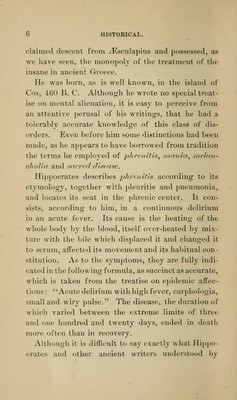
![claimed descent from ^sciilapins and possessed, as we have seen, the monopoly of the treatment of the insane in ancient Greece. He was born, as is well known, in the island of Cos, 460 B. C. Although he wrote no special treat- ise on mental alienation, it is easy to perceive from an attentive perusal of his writings, that he had a tolerablv accurate knowledoe of this class of dis- orders. E^'en before him some distinctions had been made, as he appears to have borro\\'ed from tradition the tei'ms he employed of ])hrenitis, mania,, melan- cholia and sacred disease. Hippocrates describes phrenitis according to its etymology, together with pleuritis and pneumonia, and locates its seat in the phrenic center. It con- sists, according to him, in a continuous delirium in an acute fever. Its cause is the heating of the whole body by the blood, itself over-heated by mix- ture with the bile which displaced it and changed it to serum, affected its movement and its habitual con- stitution. As to the symptoms, they are fully indi- cated in the following formula, as succinct as accurate, which is taken from the treatise on ej)idemic affec- tions : Acute delirium with high fever, carphologia, small and wirv i)ulse. The disease, the duration of \vhi(;h varied between the extreme limits of three and one hundred and twenty days, ended in death more often than in recovery. Although it is diHicidt t<» say exactly wliat Hippo- crates and otlier ancient writers understood by](https://iiif.wellcomecollection.org/image/b21209819_0030.jp2/full/800%2C/0/default.jpg)