Obstetrics : the theory and practice ; including the diseases of pregnancy and parturition, obstetrical operations, etc. / by P. Cazeaux ; remodelled and rearranged, with additions and revisions, by S. Tarnier.
- Pierre Cazeaux
- Date:
- 1885
Licence: Public Domain Mark
Credit: Obstetrics : the theory and practice ; including the diseases of pregnancy and parturition, obstetrical operations, etc. / by P. Cazeaux ; remodelled and rearranged, with additions and revisions, by S. Tarnier. Source: Wellcome Collection.
Provider: This material has been provided by The University of Leeds Library. The original may be consulted at The University of Leeds Library.
1079/1140 (page 1045)
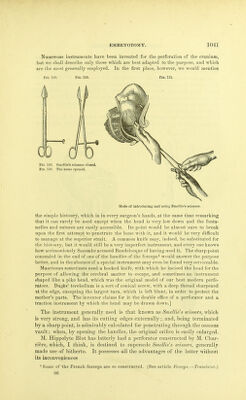
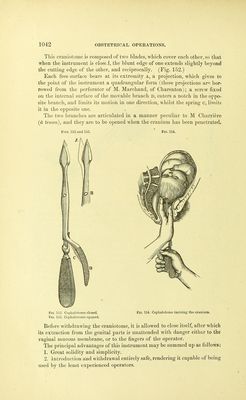
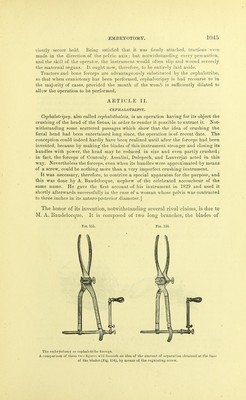
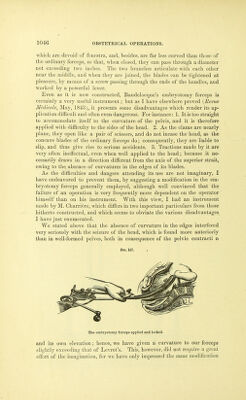
![ciently secure liold. Being satisfied that it was firmly attaclied, tractions were made ia the direction of the pelvic axis ; but notwithstanding every precaution, and the skill of the operator, the instrument would often slip and wound severely fche maternal organs. It ought now, therefore, to be entirely laid aside. Tractors and bone forceps are advantageously substituted by the cephalotribe, so that when craniotomy has been pei-formed, cephalotripsy is had recourse to in the majority of cases, provided the mouth of the wonib is sufficiently dilated to allow the operation to be performed. Cephalotripsy, also called cepJialothalsia, is an operation having for its object the crushing of the head of the foetus, in order to render it possible to extract it. Notr withstanding some scattered passages which show that the idea of crushing the foetal head had been entertained long since, the operation is of recent date. The conception could indeed hardly have been realized until after the forceps had been invented, because by makingthe blades of this instrument stronger and closing its handles with power, the head may be reduced in size and even partly crushed; in fact, the forceps of Coutouly, Assalini, Delepech, and Lauverjat acted in this way. Nevertheless the forceps, even when its handles were approximated by means of a screw, could be nothing more than a very imperfect crushing instrument. It was necessary, therefore, to contrive a special apparatus for the purpose, and this was done by A. Baudelocque, nephew of the celebrated accoucheur of the same name. He gave the first account of his instrument in 1829 and used it shortly afterwards successfully in the case of a woman whose pelvis was contracted to three inches in its antero-posterior diameter.] The honor of its invention, notwithstanding several rival claims, is due to M. A. Baudelocque. It is composed of two long branches, the blades of AKTICLE II. CEPH A LOTEIPSY. FiQ. 155. Fig. 156. The embryo*oniy or cephalotribe forceps. A comparisoa of these two figures will furnish an idea of the amount of separation obtained at the base of the blades (Fig. 156), by means of the regulating screw.](https://iiif.wellcomecollection.org/image/b21515013_1081.jp2/full/800%2C/0/default.jpg)