Obstetrics : the theory and practice ; including the diseases of pregnancy and parturition, obstetrical operations, etc. / by P. Cazeaux ; remodelled and rearranged, with additions and revisions, by S. Tarnier.
- Pierre Cazeaux
- Date:
- 1885
Licence: Public Domain Mark
Credit: Obstetrics : the theory and practice ; including the diseases of pregnancy and parturition, obstetrical operations, etc. / by P. Cazeaux ; remodelled and rearranged, with additions and revisions, by S. Tarnier. Source: Wellcome Collection.
Provider: This material has been provided by The University of Leeds Library. The original may be consulted at The University of Leeds Library.
89/1140 (page 85)
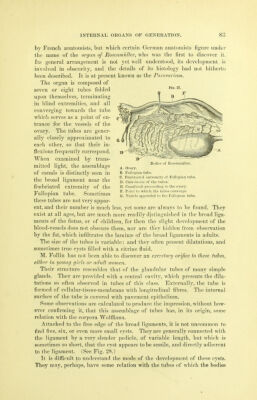
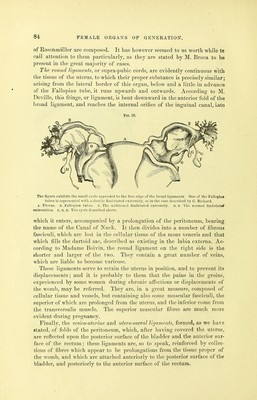
![ARTICLE III. OF THE FALLOPIAN TUBES. The uterine or Fallopian tubes are two canals, varying from four and a quarter to five inches in length, and placed in the thickness of the superior border of the broad ligament. They extend transversely from the lateral angles of the womb nearly to the iliac fossa on the corresponding side. Their volume is made more evident by inflating them. (G. Richard.) It may then be ascertained that beyond the uterine parietes, the tube has a diameter of about three-sixteenths of an inch ; towards the middle of its course it increases to about one-quarter of an inch, and just before the ostium abdominale, to five-sixteenths of an inch. Their calibre is very variable at different points. The elasticity of the walls is however so great as to allow of their increase to an enormous extent, as is proved by the cysts which are frequently found in them. The internal orifice of the tube {ostium uterinum) is stated by M. Richard to be the one-sixteenth of an inch in diameter ; from thence, the calibre of the canal increases gradually to its external orifice. Near the free extremity it spreads out and becomes fringed. This termination constitutes the pavil- ion, or fimbriated extremity (the morsus diaboli). It is generally taught that one of these fringes, which is longer than the others, attaches itself to the extremity of the ovary. On the contrary, M. Cruveilhier believes that this adherence takes place through the interven- tion of a groove, the concavity of which looks downwards and backwards, and facilitates the communication between the ovary and the cavity of the tube. All the fringed folds are attached to a small circle which is more contracted than the part of the tube which it terminates. This small circle is called the external orifice of the tube. The internal or uterine orifice is the name given to the one by which it opens in the uterine cavity. [The Fallopian tubes are composed of three layers: an external or serous, a middle or muscular, and an internal or mucous layer. The external layer is a part of the peritoneum which lines the entire length of the oviduct, and is extended to the free edge of the fimbriated extremity, where it ends abruptly. The middle layer is composed of two planes of muscular fibres — the external being longitudinal, and the internal circular. The tubes have often been described as prolongations of the uterus, whereas M. Robin regards them as entirely dis- tinct. A thin, cellular septum is, in fact, interposed between the tissues of the two organs, allowing of their separation by the scalpel. The mucous layer is continuous internally with the uterine mucous membrane, and terminates externally upon the free edge of the fimbriated extremity where it is connected with the peritoneal layer. Thus aifording the only example of a mucous membrane in continuity with a serous one. The mucous membrane of the oviduct is devoid of papilli and glands, but presents longitudinal folds so adjusted to each other as to transform the canal into numerous capillary tubes, well adapted to convey readily the spermatic fluid to the ovary. The mucous membrane is also covered with a vibratile epithelium, the motion of whose cilia being directed toward the uterus are, doubtless, intended to impel the jvuls toward the uterine orifice of the tube,]](https://iiif.wellcomecollection.org/image/b21515013_0091.jp2/full/800%2C/0/default.jpg)