Obstetrics : the theory and practice ; including the diseases of pregnancy and parturition, obstetrical operations, etc. / by P. Cazeaux ; remodelled and rearranged, with additions and revisions, by S. Tarnier.
- Pierre Cazeaux
- Date:
- 1885
Licence: Public Domain Mark
Credit: Obstetrics : the theory and practice ; including the diseases of pregnancy and parturition, obstetrical operations, etc. / by P. Cazeaux ; remodelled and rearranged, with additions and revisions, by S. Tarnier. Source: Wellcome Collection.
Provider: This material has been provided by The University of Leeds Library. The original may be consulted at The University of Leeds Library.
94/1140 (page 90)
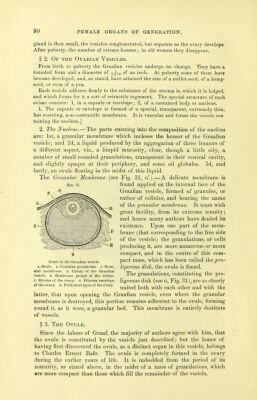
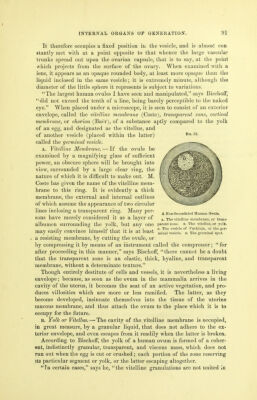
![gland is then small, the vesicles conglomerated, but separate as the ovary devtlopg. After puberty, the number of ovisacs lessens ; in old vs'omen they disappear. § 2. Of the Ovarian Vesicles. From birth to puberty the Graafian vesicles undergo no change. They have a founded form and a diameter of j-^j^ of an inch. At puberty some of them have become developed, and, as stated, have attained the size of a millet-seed, of a hemp- seed, or even of a pea. Each vesicle adheres firmly to the substance of the stroma in which it is lodged, and which furms for it a sort of retractile tegument. The special structure of each ovisac consists: 1, in a capsule or envelope; 2, of a contained body or nucleus. 1. The capsule or envelope is formed of a special, transparent, extremely thin, but resisting, non-contractile membrane. It is vascular and forms the vesicle con taining the nucleus.] 2. The Nucleus.—The parts entering into the composition of the nucleus are: 1st, a granular membrane which incloses the humor of the Graafian vesicle; and 2d, a liquid produced by the aggregation of three humors of a different aspect, viz., a limpid mucosity, clear, though a little oily, a number of small rounded granulations, transparent in their central cavity, and slightly opaque at their periphery, and some oil globules. 3d, and lastly, an ovule floating in the midst of this liquid. The Ormmlar Membrane (see Fig. 31, g'). — A delicate membrane is found applied on the internal face of the Graafian vesicle, formed of granules, or rather of cellules, and bearing the name of the granular membrane. It tears with great facility, from its extreme tenuity; and hence many authors have denied its existence. Upon one part of the mem- brane (that corresponding to the free side of the vesicle) the granulations, or cells producing it, are more numerous or more compact, and in the centre of this com- pact mass, which has been called the pro- ligerous disk, the ovule is found. The granulations, constituting the pro- ligerous disk (see G, Fig. 31), are so closely united both with each other and with the latter, that upon opening the Graafian vesicle, even where the granular membrane is destroyed, this portion remains adherent to the ovule, forming round it, as it were, a granular bed. This membrane is entirely destitute of vessels. § 3. The Ovule. Since the labors of Graaf, the majority of authors agree with him, that the ovule is constituted by the vesicle just described; but the honor of having first discovered the ovule, as a distinct organ in this vesicle, belongs to Charles Ernest Baer. The ovule is completely formed in the ovary during the earlier years of life. It is imbedded from the period of its maturity, as stated above, in the midst of a mass of granulations, which Bre more compact, than those which fill the remainder of the vesicle. Fio. 31. Ovule in the Graafian vesicle. A. Ovule. B. Cumulus granulosus, c. Gran- ular membrane, d. Cavity of the Graafian vesicle. E. Membrane proper of the ovisac. F. Stroma of the ovary. G. Fibrous envelope of the ovary, h. Peritoneal layer of the ovary.](https://iiif.wellcomecollection.org/image/b21515013_0096.jp2/full/800%2C/0/default.jpg)