Elements of general radio-therapy for practitioners / by Leopold Freund ; translated by G.H. Lancashire.
- Freund, Leopold.
- Date:
- 1904
Licence: In copyright
Credit: Elements of general radio-therapy for practitioners / by Leopold Freund ; translated by G.H. Lancashire. Source: Wellcome Collection.
Provider: This material has been provided by The University of Glasgow Library. The original may be consulted at The University of Glasgow Library.
619/646 (page 47)
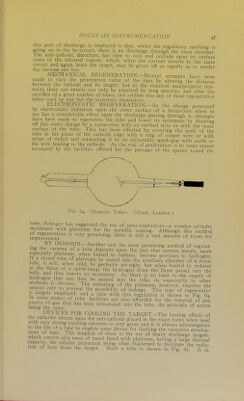
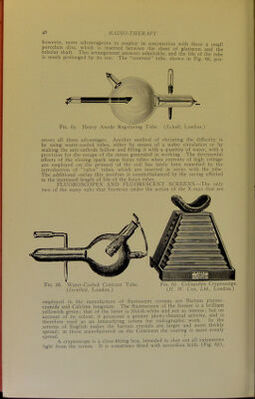
![me path of discharge is employed is that, whilst the regulatory sparking is going on in the by-circuit, there is no discharge through the main chamber. I he anti-cathode, therefore, has time to cool and occlude upon its surface some of the released vapour, which, when the current reverts to the main circuit and again heats the target, may be given off so rapidly as to render the vacuum too low. MECHANICAL REGENERATION.—Several attempts have been made to vary the penetration value of the rays by altering the distance between the cathode and its target; but as the required manipulative dex- terity their use entails can only be acquired by long practice, and after the sacrifice of a great number of tubes, one seldom sees any of these regenerative tubes used by any but the inventors themselves. ELECTROSTATIC REGENERATION.—As the charge generated by electrostatic induction upon the outer surface of a focus-tube when in use has a considerable effect upon the discharge passing through it attempts have been made to regenerate the tube and lower its resistance by drawing off this outer charge by a connection with an earthed wire or with the inner surface of the tube. This has been effected by covering the neck of the tube m the plane of the cathode edge with a ring of copper wire or with strips of tinfoil and connecting it by an adjustable spark-gap with earth or the wire leading to the cathode. As the risk of perforation is to some extent increased by the facilities offered for the passage of the sparks round the Fig. 64. Osmosis Tubes. {Dean, London.) mnflJniA^u*5! SUS??sted the use of semi-conductors-a wooden cylinder of retZtJ .g'ycerme for the metallic coating. Although this method °mProgvement 1 ^ pr0miSmg' there is sti11 a vast am°™t of room for BY OSMOSIS.—Another and the most promising method of reeulat- ensneH,llvVan^m ° * ^ dePends P°n the fact that certain metals, more especially platinum, when heated to redness, become pervious to hydrogen. tnhe I will , 01 Plat',m!m be rsealed into the auxiliary chamber of a focus n tl'J fl ' W< co,.d>,be Perfectly air-tight, but when heated to redness ,n \ i,T ,a sP,nt-]amP>. the hydrogen from the flame passes into the hi ™™ W VC!V lts,reslsta»ce- As there is no limit to the supply of Slwk i f Ca thnf be pasfed into the tube> its superiority to other ™S lh °bvl°tis. Ihe annealing of the platinum, however, requires the utmost care to prevent the possibility of leakage. This type of regenerator is largely employed, and a tube with this regulation is shown in Fig 64 n some makes of tube facilities are also afforded for the removal of any being the fame introduced into the tube, the principle of action DEVICES FOR COOLING THE TARGET.—The heating effects of tile cathodiC stream upon the anti-cathode placed in the exact focus when used with very strong exciting currents is very great and it is always advantageous to the lite ot a tube to employ some device for limiting the excessive develop- ment oi heat. Ihe simplest of these is the use of heavy discharge targets which consist of a mass of metal faced with platinum, having a large thermal capacity the tubular projection being often blackened to facilitate the radia- tion of heat from the target. Such a lube is shown in Fig 65 It is](https://iiif.wellcomecollection.org/image/b21461491_0619.jp2/full/800%2C/0/default.jpg)