The problem of age, growth, and death / [by] Charles Sedgwick Minot.
- Charles Sedgwick Minot
- Date:
- 1907
Licence: Public Domain Mark
Credit: The problem of age, growth, and death / [by] Charles Sedgwick Minot. Source: Wellcome Collection.
Provider: This material has been provided by the Augustus C. Long Health Sciences Library at Columbia University and Columbia University Libraries/Information Services, through the Medical Heritage Library. The original may be consulted at the the Augustus C. Long Health Sciences Library at Columbia University and Columbia University.
38/132 page 112
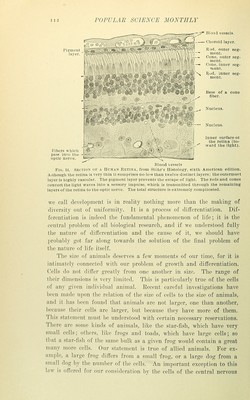
![Blood vessels. ment. ili-— Cone, outer seg- A^ ment. IP;* Cone, inner seg- '^^l ruent. is^^'^v^ Rod, inner seg- O ment. ^' fg^yji.'^!^] Base of a cone Nucleus. Nucleus. Inner surface ot the retina (to- ward ttie light). Fibers which pass inio the optic nerve. Blood vessels Fig. 16. Section of a Human Retina, from Stohr's Histology, sixth American edition. Aithough the retina is very thin it comprises no le?s than twelve distinct layers; the outermost layer is highly vascular. The pigment layer prevents the escape of light. The rods and cones convert the light waves into a sensory impulse, which is transmitted through the remaining layers of the retina to the optic nerve. The total structure is extremely complicated. we call develoiDiiient is in reality nothing more than the making of diversity out of uniformity. It is a process of differentiation. Dif- ferentiation is indeed the fundamental phenomenon of life; it is the central problem of all biological research, and if we understood fully the nature of differentiation and the cause of it, we should have probably got far along towards the solution of the final problem of the nature of life itself. The size of animals deserves a few moments of our time, for it is intimately connected with our problem of growth and differentiation. Cells do not differ greatly from one another in size. The range of their dimensions is very limited. This is particularly true of the cells of any given individual animal. Eecent careful investigations have been made upon the relation of the size of cells to the size of animals, and it has been found that animals are not larger, one than another, because their cells are larger, but because they have more of them. This statement must be understood with certain necessary reservations. There are some kinds of animals, like the star-fish, which have very small cells; others, like frogs and toads, which have large cells; so that a star-fish of the same bulk as a given frog would contain a great many more cells. Our statement is true of allied animals. For ex- ample, a large frog differs from a small 'frog, or a large dog from a small dog by the number of the cells. An important exception to this law is offered for our consideration by the cells of the central nervous](https://iiif.wellcomecollection.org/image/b21212806_0038.jp2/full/800%2C/0/default.jpg)