The problem of age, growth, and death / [by] Charles Sedgwick Minot.
- Charles Sedgwick Minot
- Date:
- 1907
Licence: Public Domain Mark
Credit: The problem of age, growth, and death / [by] Charles Sedgwick Minot. Source: Wellcome Collection.
Provider: This material has been provided by the Augustus C. Long Health Sciences Library at Columbia University and Columbia University Libraries/Information Services, through the Medical Heritage Library. The original may be consulted at the the Augustus C. Long Health Sciences Library at Columbia University and Columbia University.
94/132 page 459
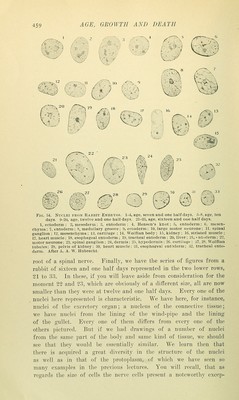
![Fig. 54. Nuclei FROM Rabbit Embryos. 1-4, age, seven and one half days. 5-8, age, ten days. 9-20, age, twelve and one half days. 2]-33, age, sixteen and one half days. 1, ectoderm ; 2, mesoderm; 3, entoderm; 4, Hensen's knot; 5, entoderm; 6, mesen- chyma; 7, entoderm; 8, medullary groove; 9, ectoderm; 10, large motor neurone; 11. spinal ganglion; 12, mesenchyma; 13, cartilage ; 14, Wolfiian body; 15, kidney; 16, striated muscle ; 17, heart muscle; 18, esophageal entoderm; 19, tracheal entoderm; 20, liver; 21, --ntiiderm; 22, motor neurone; 23, spinal ganglion ; 24, dermis ; 25, hypodermis ; 26. cartilage ; 27, 28, Wolffian tubules; 29, pelvis of kidney ; 30, heart muscle; 31, esophageal entoderm; 32, tracheal ento- derm. After A. A. W. Hubrecht. root of a spinal nerve. Finally, we have the series of figures from a rabbit of sixteen and one half days represented in the two lower rows, 21 to 33. In these, if yon will leave aside from consideration for the moment 22 and 23, which are obviously of a different size, all are now smaller than they were at twelve and one half days. Every one of the nuclei here represented is characteristic. We have here, for instance, nuclei of the excretory organ; a nucleus of the connective tissue; we have nuclei from the lining of the wind-pipe and the lining of the gullet. Every one of them differs from every one of the others pictured. But if we had drawings of a number of nuclei from the same part of the body and same kind of tissue, we should see that they would be essentially similar. We learn then that there is acquired a great diversity in the structure of the nuclei as well as in that of the protoplasm, of which we have seen so many examples in the previous lectures. You will recall, that as regards the size of cells the nerve cells present a noteworthy excep-](https://iiif.wellcomecollection.org/image/b21212806_0094.jp2/full/800%2C/0/default.jpg)