Evolution of sex in plants / by John Merle Coulter.
- Coulter John Merle, 1851-1928.
- Date:
- [1914]
Licence: In copyright
Credit: Evolution of sex in plants / by John Merle Coulter. Source: Wellcome Collection.
Provider: This material has been provided by the Royal College of Physicians of Edinburgh. The original may be consulted at the Royal College of Physicians of Edinburgh.
38/160 (page 24)
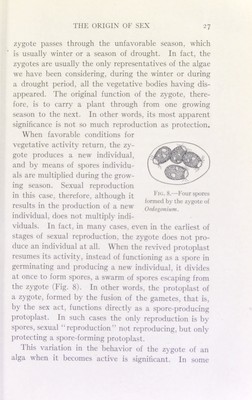
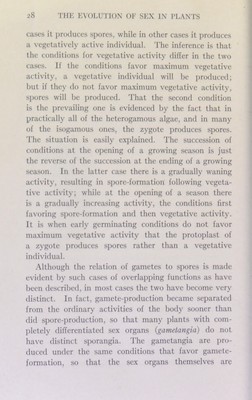
![gamete-i)ro(luction, and so the two may appear together in a ]dant, but they are really differentiated by condi- tions, and usually distinctly separate in the time of appearance. It has been found possible to control ex- perimentally among the algae the conditions that deter- mine these various activities. The plant may be kept in vegetative activity indefinitely; it may be made to pro- duce spores at any time; or it may be made to produce gametes. The distribution of these functions in the ordinary^ life history of the jilant is naturally related to its changing environment. It begins the season with vegetative activity; later the conditions that favor luxuriant growth decline somewhat, and spore-formation begins. It is in this second period that the greatest multijrlication of individuals occurs, so that although the plants are sexual, the chief amount of reproduction is by means of the asexual spores. In such algae as are being used as illustrations, the jiroduction of gametes is the last act in the life of the plant, an act induced by conditions that are bringing the activity of the plant to a close. If the original difference between spores and gametes be considered, it seems evident that it depends upon the number of times the material of a protoplast is divided. If it is not divided at all, or only a few times, the cells produced are spores; if the divisions are more numerous, the cells produced are probably gametes. The condi- tions that favor gamete-formation rather than spore- formation, therefore, are conditions that favor successive divisions of the protoplast body before discharge. I he divisions are regular cell divisions, which are soon checked in spore-formation but continue much longer](https://iiif.wellcomecollection.org/image/b2172989x_0038.jp2/full/800%2C/0/default.jpg)