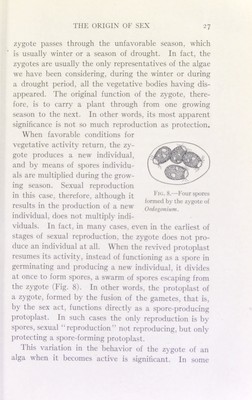
Evolution of sex in plants / by John Merle Coulter.
- Coulter John Merle, 1851-1928.
- Date:
- [1914]
Licence: In copyright
Credit: Evolution of sex in plants / by John Merle Coulter. Source: Wellcome Collection.
Provider: This material has been provided by the Royal College of Physicians of Edinburgh. The original may be consulted at the Royal College of Physicians of Edinburgh.
42/160 (page 28)
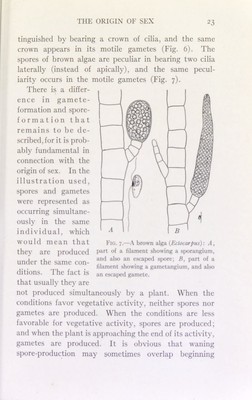
![cases it produces spores, while in other cases it produces a vegetatively active individual. 'Fhe inference is that the conditions for vegetative activity dilTcr in the two cases. If the conditions favor ma.ximum vegetative activity, a vegetative individual will be produced; but if they do not favor maximum vegetative activity, spores will be produced. That the second condition is the i)revailing one is evidenced by the fact that in practically all of the heterogamous algae, and in many of the isogamous ones, the zygote produces spores. 'Fhe situation is easily ex])lained. The succession of conditions at the opening of a growing season is just the reverse of the succession at the ending of a growing season. In the latter case there is a gradually waning activity, resulting in spore-formation following vegeta- tive activity; while at the opening of a season there is a gradually increasing activity, the conditions first favoring spore-formation and then vegetative activity. It is when early germinating conditions do not favor maximum vegetative activity that the protoplast of a zygote produces spores rather than a vegetative individual. Although the relation of gametes to spores is made evident by such cases of overlapping functions as have been described, in most cases the two have become very distinct. In fact, gamete-production became separated from the ordinaiy^ activities of the body sooner than did spore-production, so that many plants with com- pletely differentiated sex organs {gamdangia) do not have distinct sporangia. The gametangia are pro- duced under the same conditions that favor gamete- formation, so that the sex organs themselves are](https://iiif.wellcomecollection.org/image/b2172989x_0042.jp2/full/800%2C/0/default.jpg)