Evolution of sex in plants / by John Merle Coulter.
- Coulter John Merle, 1851-1928.
- Date:
- [1914]
Licence: In copyright
Credit: Evolution of sex in plants / by John Merle Coulter. Source: Wellcome Collection.
Provider: This material has been provided by the Royal College of Physicians of Edinburgh. The original may be consulted at the Royal College of Physicians of Edinburgh.
84/160 (page 70)
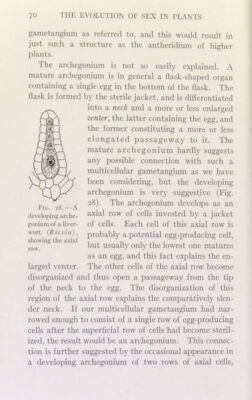
![gametangium as referred to, and this would result in just such a structure as the antheridium of higher plants. 'I'he archegonium is not so easily explained. A mature archegonium is in general a flask-shaped organ containing a single egg in the bottom of the flask. 'Lhe flask is formed by the sterile jacket, and is differentiated into a neck and a more or less enlarged venter, the latter containing the egg, and the former constituting a more or less elongated passageway to it. The mature archegonium hardly suggests any possible connection with such a multicellular gametangium as we have been considering, but the developing archegonium is very suggestive (Fig. 28). The archegonium develops as an axial row of cells invested by a jacket of cells. Each cell of this axial row is probably a potential egg-producing cell, but usually only the lowest one matures as an egg, and this fact explains the en- The other cells of the axial row become disorganized and thus open a ])as.sageway from the tip of the neck to the egg. d'he disorganization of this region of the axial row explains the comj)aratively slen- der neck. If our multicellular gametangium had nar- rowed enough to consist of a single row of egg-producing cells after the superficial row of cells had become steril- ized, the result would be an archegonium. d'his connec- tion is further suggested by the occasional appearance in a developing archegonium of two rows of axial cells. Eig. 28. — A (IcvelopinR archc- Ronium of a liver- wort {Riccia), showing the axial row. larged venter.](https://iiif.wellcomecollection.org/image/b2172989x_0084.jp2/full/800%2C/0/default.jpg)