Evolution of sex in plants / by John Merle Coulter.
- Coulter John Merle, 1851-1928.
- Date:
- [1914]
Licence: In copyright
Credit: Evolution of sex in plants / by John Merle Coulter. Source: Wellcome Collection.
Provider: This material has been provided by the Royal College of Physicians of Edinburgh. The original may be consulted at the Royal College of Physicians of Edinburgh.
86/160 (page 72)
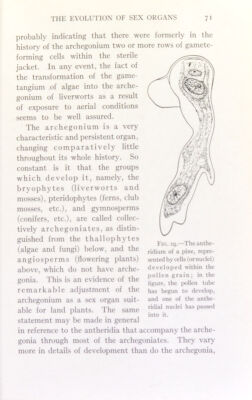
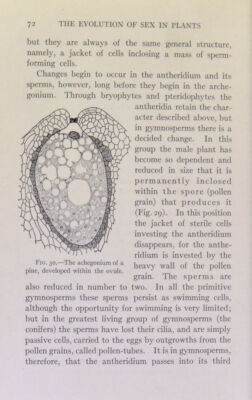
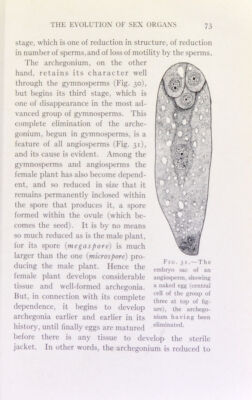
![l)ut they are always of the same general structure, namely, a jacket of cells inclosing a mass of sperm- forming cells. Changes begin to occur in the antheridium and its s])erms, however, long before they begin in the arche- gonium. d'hrough biyophytes and pteridojdiytes the antheridia retain the char- acter described above, but in g>’mnosperms there is a decided change. In this group the male plant has become so dependent and reduced in size that it is permanently inclosed within the spore (pollen grain) that produces it (Fig. 29). In this position the jacket of sterile cells investing the antheridium disappears, for the anthe- ridium is invested by the • '■■■“•^'’•-Thea'iwniumora pmc, developed within the ovule. gram. The sperms are also reduced in number to two. In all the i)rimitive g}-mnosperms these sperms persist as swimming cells, although the opportunity for swimming is very limited; but in the greatest living group of gymnosperms (the conifers) the sperms have lost their cilia, and are simply passive cells, carried to the eggs by outgrowths from the pollen grains, called pollen-tubes. It is in gymnosperms, therefore, that the antheridium passes into its third](https://iiif.wellcomecollection.org/image/b2172989x_0086.jp2/full/800%2C/0/default.jpg)