Evolution of sex in plants / by John Merle Coulter.
- Coulter John Merle, 1851-1928.
- Date:
- [1914]
Licence: In copyright
Credit: Evolution of sex in plants / by John Merle Coulter. Source: Wellcome Collection.
Provider: This material has been provided by the Royal College of Physicians of Edinburgh. The original may be consulted at the Royal College of Physicians of Edinburgh.
92/160 (page 78)
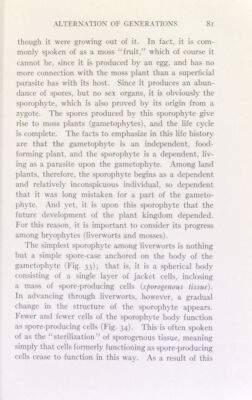
![rej^roduclion, is the l)asis of alternation of generations, which in most i)lants comes to ex]>ress itself in alternating individuals. The simplest expression of alternation among plants, beyond mere alternation in the number of chromosomes, is shown by those algae whose zygotes do not produce individuals like those from which they come, but pro- duce spores, which in turn produce new individuals. In other words, the zygote is a spore-jiroducing body, which is really the definition of a sporophyte. In such ])lants, therefore, there are two sets of spores, one set produced in the ordinary^ way by the working body of the plant, and the other set produced by the zygotes. If the zygotes, instead of producing free spores, had produced a spore-forming structure, this structure would rejiresent an individual different from the ordinary' one, and alternating individuals would be evident. d'he appearance of a sjiorophyte in a life cycle, there- fore, is the apjiearance of a new individual produced by the zygote, w'hich is prophesied by the sex act, begins to appear in spores formed by the zygote, and finally becomes a spore-forming individual produced by a zygote. This means that the older individual histori- cally in the alternation is the gametophyte, which finally eliminates spore-production, and the alternation in function becomes complete. Among some of the red algae, alternation of gen- erations has reached an advanced stage, for the spore-bearing individual produced by the zygote is as conspicuous as the gametophyte. In fact, the alternat- ing individuals resemble one another so closely that they are recognized only by the organs they produce.](https://iiif.wellcomecollection.org/image/b2172989x_0092.jp2/full/800%2C/0/default.jpg)