The constituents of commercial chrysarobin / by H.A.D. Jowett, and C.E. Potter.
- Jowett, H. A. D. (Hooper Albert Dickinson)
- Date:
- [1902]
Licence: In copyright
Credit: The constituents of commercial chrysarobin / by H.A.D. Jowett, and C.E. Potter. Source: Wellcome Collection.
11/16 (page 1583)
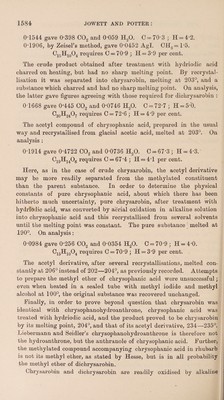
![melted at 125° and gave the following data: C = 68*0; H = 5*0 per cent. Mol. wt. = 692. Hesse supposed that his substance was produced by the polymerisation of chrysarobin by the prolonged action of the acetylating agent. This, however, we find not to be the case, as the mixture of chrysarobin and dichrysarobin methyl ether, when treated with acetic anhydride and sodium acetate for half-an-hour, gave approximately equal quanti¬ ties of triacetylchrysarobin and penta-acetyldichrysarobin methyl ether, whilst pure chrysarobin under exactly similar conditions gave a quantitative yield of triacetylchrysarobin. The polymeride, therefore, must pre-exist in the mixture. That it was a methyl ether was proved by treating the mixture with hydriodic acid and examining the alkyl iodide formed ; it distilled completely below 50° and was therefore methyl iodide. Substanee, Cl7H1404. M. p. 181°. In the process of working up the residual crude chrysarobin left after extraction with light petroleum, a small amount of a beautiful, crystalline substance melting constantly at 181° was obtained. It had the general properties of the substances associated with it in crude chrysarobin. On analysis : 0*108 gave 0-285 C02 and 0*052 H20. 0 = 72*0; 11 = 5*3. 0-19, by Zeisel's method, gave 0-141 Agl. CH3 = 4‘7. Cl7H]404 requires O = 72-3 ; H = 5*0; CH3 = 5*3 per cent. The analytical data agree very well with this formula, and the large amount of methyl iodide formed on treatment with hydriodic acid precludes the possibility of it being a mixture of the other constituents previously mentioned. The acetyl compound, prepared in the usual way, was crystallised from alcohol and formed orange-red crystals melting at 215—216°. The solution was not fluorescent. On analysis : 0-0938 gave 0*2276 C02 and 0*042 H2G. 0 = 66*2 ; H = 5*0 per cent. These figures unfortunately do not agree well with any likely formula, and we are unable at this stage of the inquiry to offer any suggestions as to the constitution of this substance. Chrysophanic Acid, C15H10O4. For the sake of comparison, a preliminary examination was made of some chrysophanic acid prepared from rhubarb. This was obtained as a brown, indistinctly crystalline powder melting at 160°. On analysis :](https://iiif.wellcomecollection.org/image/b30602701_0011.jp2/full/800%2C/0/default.jpg)