On the heating effects of electricity and magnetism / W.R. Grove.
- William Robert Grove
- Date:
- [1852]
Licence: Public Domain Mark
Credit: On the heating effects of electricity and magnetism / W.R. Grove. Source: Wellcome Collection.
Provider: This material has been provided by The Royal College of Surgeons of England. The original may be consulted at The Royal College of Surgeons of England.
6/6 (page 124)
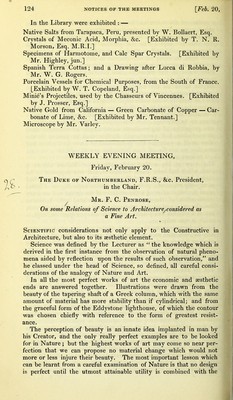
![In the Library were exhibited : — Native Salts from Tarapaca, Peru, presented by W. Bollaert, Esq. Crystals of Meconic Acid, Morphia, &c. [Exhibited by T. N. R. Morson, Esq. M.R.I.] Specimens of Harmotome, and Calc Spar Crystals. [Exhibited by Mr. Highley, jun.] Spanish Terra Cottas; and a Drawing after Lucca di Robbia, by Mr. W. G. Rogers. Porcelain Vessels for Chemical Purposes, from the South of France. [Exhibited by W. T. Copeland, Esq.] Minie’s Projectiles, used by the Chasseurs of Vincennes. [Exhibited by J. Prosser, Esq.] Native Gold from California — Green Carbonate of Copper — Car- bonate of Lime, &c. [Exhibited by Mr. Tennant.] Microscope by Mr. Varley. WEEKLY EVENING MEETING, Friday, February 20. The Duke of Northumberland, F.R.S., &c. President, in the Chair. Mr. F. C. Penrose, On some Relations of Science to Architecture,considered as a Fine Art. Scientific considerations not only apply to the Constructive in Architecture, but also to its aesthetic element. Science was defined by the Lecturer as “ the knowledge which is derived in the first instance from the observation of natural pheno- mena aided by reflection upon the results of such observation,” and he classed under the head of Science, so defined, all careful consi- derations of the analogy of Nature and Art. In all the most perfect works of art the economic and aesthetic ends are answered together. Illustrations were drawn from the beauty of the tapering shaft of a Greek column, which with the same amount of material has more stability than if cylindrical; and from the graceful form of the Eddystone lighthouse, of which the contour was chosen chiefly with reference to the form of greatest resist- ance. The perception of beauty is an innate idea implanted in man by his Creator, and the only really perfect examples are to be looked for in Nature; but the highest works of art may come so near per- fection that we can propose no material change which would not more or less injure their beauty. The most important lesson which can he learnt from a careful examination of Nature is that no design is perfect until the utmost attainable utility is combined with the](https://iiif.wellcomecollection.org/image/b22377037_0008.jp2/full/800%2C/0/default.jpg)