Chemical and physical researches / by Thomas Graham ... ; collected and printed for presentation only ; preface and analytical contents by R. Angus Smith.
- Thomas Graham
- Date:
- 1876
Licence: Public Domain Mark
Credit: Chemical and physical researches / by Thomas Graham ... ; collected and printed for presentation only ; preface and analytical contents by R. Angus Smith. Source: Wellcome Collection.
79/738 page 17
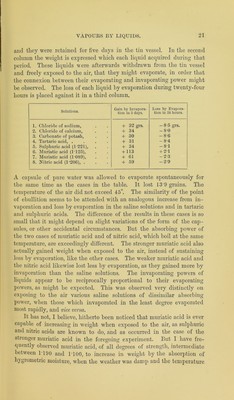
![ture and carbonic acid from the atmosphere. It would still, however, be a curious subject of inquiry—whether these soils and chalks do not, in some cases, contain within themselves the carbonic acid necessary in conjunction with water to effect their partial solution, and be thus enabled to act to a greater extent upon the absorbed oxygen and azote —the elements of nitric acid ? Should this theory of the instrumentality of carbonic acid, in nitrifi- cation, be eventually substantiated, several improvements, in the artificial production of nitre, might evidently be deduced from it. IY. EXPERIMENTS ON THE ABSORPTION OF VAPOURS BY LIQUIDS. From Edin. Journ. of Science, xvi. 1828, pp. 326-335. [Schweigger, Journ. liii. (=Jahrb. xxiii.) 1828, pp. 249-264.] From theoretical considerations I was led to institute the following experiment:—Into a deep cylindrical jar as much water was poured as covered the bottom of it to the depth of half an inch. Within the jar, and an inch above the surface of the water, a porcelain basin, three inches in diameter, was supported, containing 500 grains of a saturated solution of chloride of sodium of the temperature 57°, which was ob- served to be also the temperature of the water below and of the air without. The mouth of the jar was finally covered over by a glass plate, and made nearly air-tight by means of lard. It was intended by this arrangement to preserve the solution of chloride of sodium in an atmos- phere saturated, or nearly so, with aqueous vapour, to be supplied by the water at the bottom of the jar. For comparison another arrangement of a similar nature was made at the same time, with the only difference, that the porcelain basin contained 500 grains pure water instead of a saline solution. The two jars were set aside in a quiet place, not subject to great variations in temperature, and a specimen of the dry chloride of sodium made use of, was exposed freely to the air in their neighbour- hood. At thef expiration of six days the whole were examined: the salt exposed to the air did not present the slightest appearance of deli- quescence. The basin of pure water in the second jar had lost three grains in weight, but the solution of chloride of sodium had increased in weight by 63 grains. This solution possessed no power to absorb and condense vapour from a temperature originally lower than that of the 1 Read before the Royal Society of Edinburgh, March 3, 1S28, then communicated to the Edin. Journal of Science. B](https://iiif.wellcomecollection.org/image/b28065232_0081.jp2/full/800%2C/0/default.jpg)

 No text description is available for this image
 No text description is available for this image
 No text description is available for this image