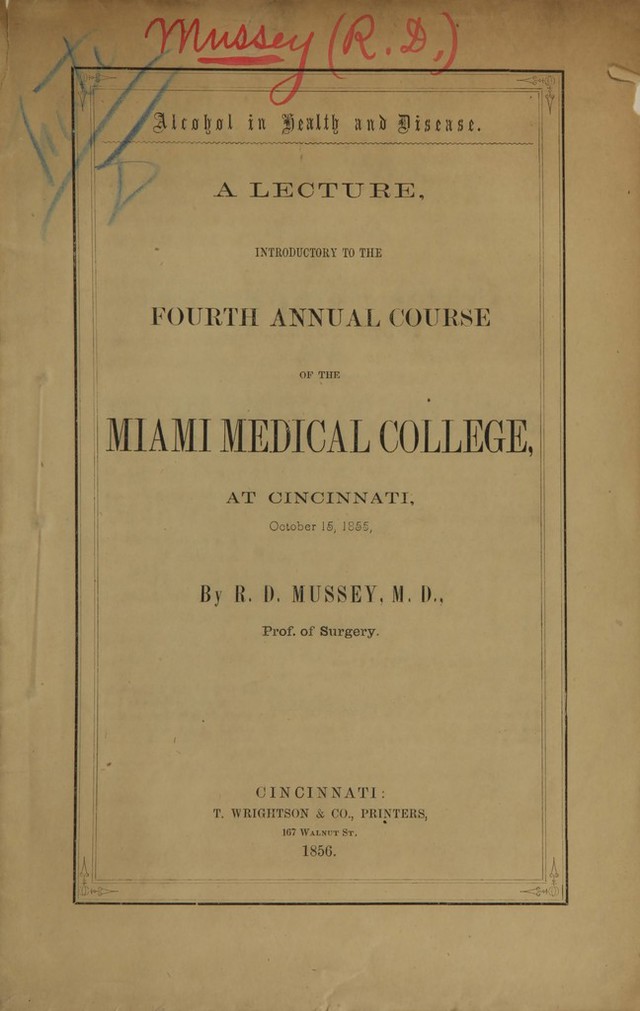
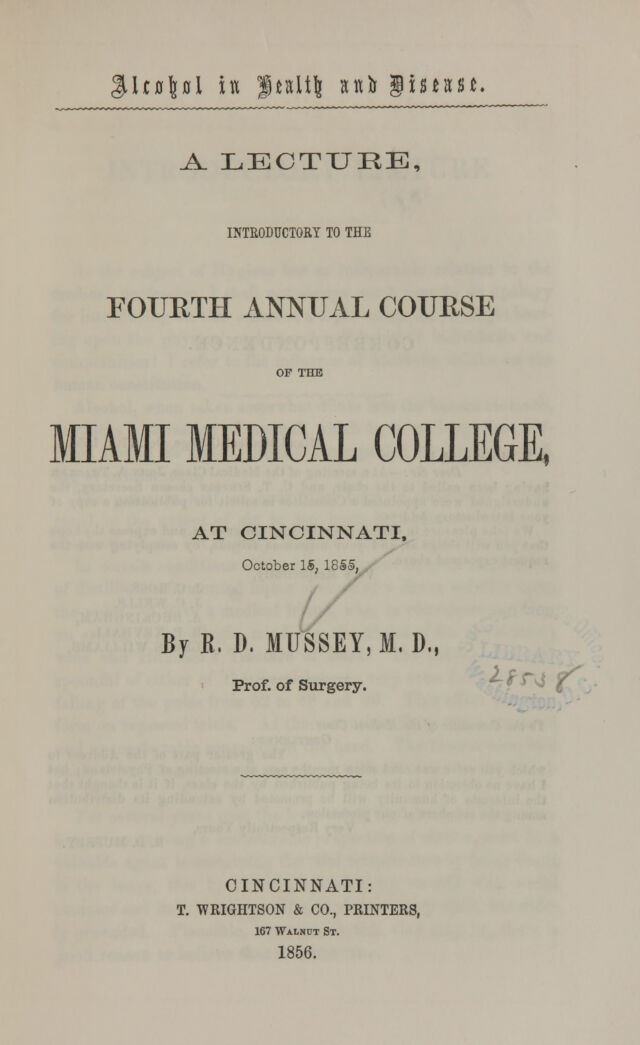
Alcohol in health and disease : a lecture introductory to the fourth annual course of the Miami Medical College, at Cincinnati, October 15, 1855 / by R.D. Mussey.
- Reuben Dimond Mussey
- Date:
- 1856
Licence: Public Domain Mark
Credit: Alcohol in health and disease : a lecture introductory to the fourth annual course of the Miami Medical College, at Cincinnati, October 15, 1855 / by R.D. Mussey. Source: Wellcome Collection.
Provider: This material has been provided by the National Library of Medicine (U.S.), through the Medical Heritage Library. The original may be consulted at the National Library of Medicine (U.S.)
7/24
![bonic acid, and other effete or foreign matters,—and to cast off or absorb water in proportion to its excess or deficiency in the circulation. Alcohol, either undecomposed or in the form of Aldehyde, [See note A,] is capable of existing for a length of time in the blood, and passes out by the kidneys, skin and lungs. Dr. Percy found it in the urine; it is often observed in the perspiration, and who has not a thousand times smelt it as it is poured from the lungs at every breath? That it is capable of existing largely in the blood is unquestionable. A medical friend in New Hampshire, Dr. J. C. Hanson, about twenty years ago bled a man who had been drinking freely for three or four days. The halitus of the blood burned for thirty seconds, with a blue flame, on the application of a lighted taper. From the experiments of Dr. Prout, it is plain that alcohol so interferes with or prevents the healthy vital processes, as to cause the blood to retain an undue proportion of carbonic acid; for the Doctor found that after the alcoholic influence of the wine taken with his dinner had passed off, the exhalation of this acid re- curred, and in a degree somewhat above the ordinary standard. It is stated that the air in a diving-bell is sooner exhausted when the diver has taken distilled or fermented liquor, than when his drink has been water only. This being the case, it should seem that the alcohol, in some manner, steals away the oxygen of the blood to no useful purpose, but to its detriment, as it in- terferes with the escape of its effete materials. The very interesting and valuable experiments of our coun- tryman, Prof. N. S. Davis, have gone a step farther. They ex- hibit a manifest diminution of the vital temperature under the influence of alcohol. In the year 1850, says Dr. Davis, I devised a series of experiments designed to test more fully the effects of alco- hol on the functions of respiration, circulation and animal heat. These experiments, commenced in the winter of 1850, have been continued from time to time since. The apparatus for performing the experiments consisted of a glass tube, graduated so as to indicate the fractions of a cubic inch, a very delicately](https://iiif.wellcomecollection.org/image/b21143262_0007.jp2/full/800%2C/0/default.jpg)


 No text description is available for this image
 No text description is available for this image
 No text description is available for this image