[Report 1950] / Medical Officer of Health, Darlington County Borough.
- Darlington (England). County Borough Council.
- Date:
- 1950
Licence: Attribution 4.0 International (CC BY 4.0)
Credit: [Report 1950] / Medical Officer of Health, Darlington County Borough. Source: Wellcome Collection.
98/108 page 16
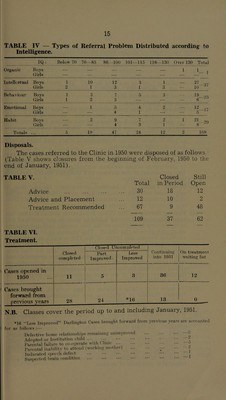
![Conclusion :— With the exceptions already noted we feel that the chief conclusion to be drawn from this report is that its findings are not noticeably different from those of previous years with the exception that the results of the increased emphasis on treatment-function of a Clinic, can be seen by a comparison of the Darlington portion of Table VI with j the corresponding Table of our 1949 Report. The number of closures I is doubled (87 as against 42), while the treatment waiting list is con- I siderably less (12 as against 33). ; Points from the Year’s Work: j (1) Housing- — In four cases re-housing was clearly indicated as I a major requirement for improvement. In one of these cases | the parents’ names have been on the waiting list since they t were married — some 8 years ago. While the housing author- ,■ ity is sympathetic it appears that no provision exists on the j system in force for the acceptance of other than more purely : medical recommendations. i (2) Speech Defects — We regret that we have neither the time nor j a good deal of the technical training to give more assistance j to Darlington school children suffering from speech defects. \ The acquisition of the services of a qualified speech therapist -] would be a great asset. j (3) Parents’ Cliirics — It becomes increasingly obvious that in i. many cases referred to us, treatment within the context of the 1 child’s problem alone is not sufficient and that a Parents’ Clinic } is a necessity which merits consideration. ^ (4) Visiting- Service — The Clinic Psychiatric Social Worker has been able to afford us two half-day sessions per month of her ; valuable time in addition to the two weekly half-day sessions which she gives in the Clinic. This enables us to extend our activities beyond the limits of the Clinic walls in respect of ' most urgent cases. Nevertheless, the lack of a more com- i prehensive visiting service is severely felt and we feel sure j that many of our cases would make quicker progress, and ' many homes where there is either difficulty or reluctance to attend the Child Guidance Clinic regularly, could be kept in satisfactory contact if we were so fortunate as to obtain at ! least a half-time Psychiatric Social Worker. (5) We have very s,trong evidence of, and faith in, the value of Nursery Schools as socialising and readjusting agencies for children of below school age. (6) Delinquency — (a) We recommend that where the Juvenile Court is considering the possibility of Child Guidance Clinic assistance for young offenders, the case should be referred for examination and report only in the first instance. This is recommended because in many cases of delinquency it is possible at quite an early stage to predict the likelihood of success or failure by a careful study of the factors operating in the case. A condition of attendance could then be made if there were reasonable prospects of success.](https://iiif.wellcomecollection.org/image/b29149319_0098.jp2/full/800%2C/0/default.jpg)