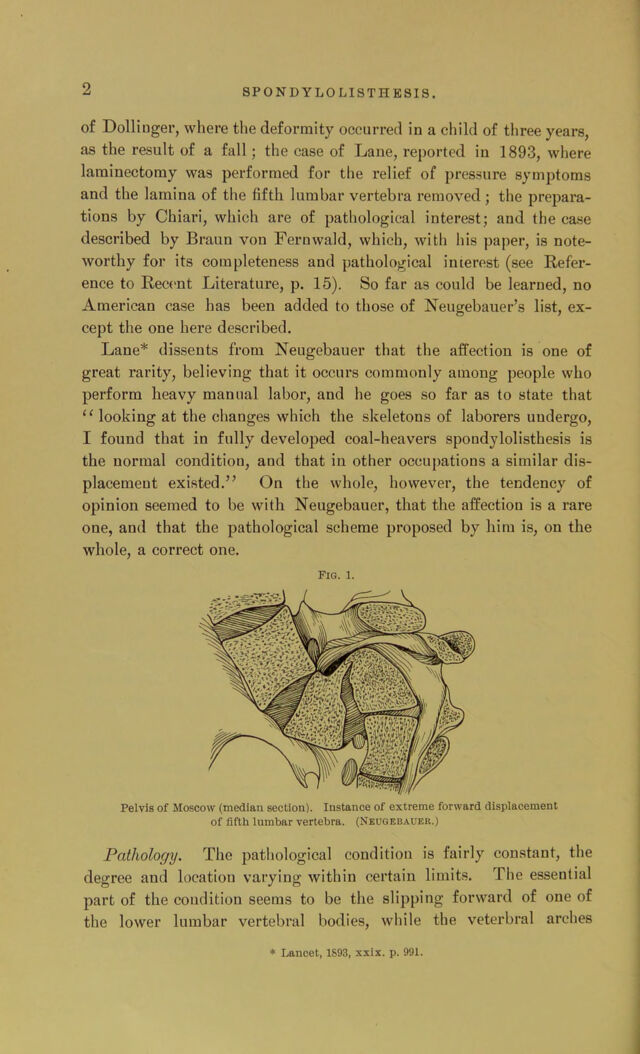
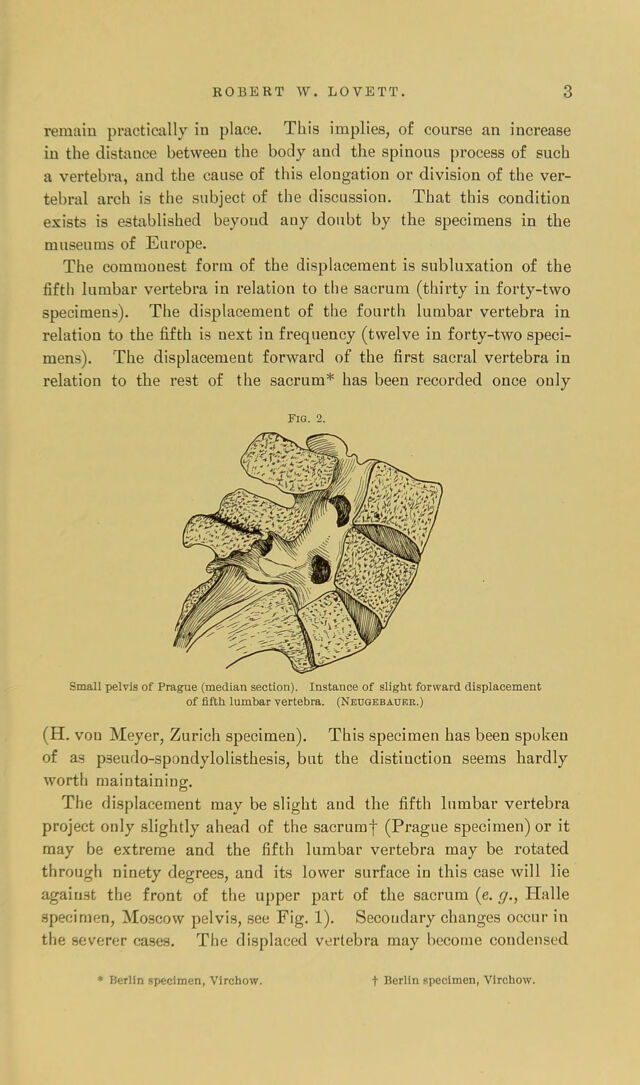
Spondylolisthesis : with description of a case / by Robert W. Lovett.
- Robert W. Lovett
- Date:
- 1897
Licence: Public Domain Mark
Credit: Spondylolisthesis : with description of a case / by Robert W. Lovett. Source: Wellcome Collection.
Provider: This material has been provided by The Royal College of Surgeons of England. The original may be consulted at The Royal College of Surgeons of England.
12/16 page 12
![tissues have resumed as normal a position as possible. This period must, of course, last for mouths, or iu cases of great deformity it would seem as if a fixation support must be permanent. General- izations from one case are of little value, but in the case recorded the greatest benefit was found at once from the application of a plaster jacket. Laminectomy, as demonstrated by the case of Mr. Lane, is an operation to be considered where symptoms of bony pressure are present for any length of time. He found, however, the. greatest difficulty iu removing the lamina, which was in this case somewhat displaced forward. On opening the spinal canal it was evident that bony pressure existed by the bulging of the com- pressed parts. In Gibney's case an unsuccessful attempt was made to reduce the deformity under ether. [Note.—A complete index of literature previous to 1890 is to be found in Neugebauer's monograph, Spondolisthesis et Spondy- UzSme, Paris, 1892, G. Steinheil, editeur.] William C, eighteen years old, a young man at school, was referred to me on September 5, 1896, by Dr. J. E. Garland, of Gloucester. He had always been fairly well except as a baby, when he had been sickly, with no especial disease. Later he grew strong, and as a boy and young man was free from all disability, athletic, well developed, and of good physique. There was nothing unusual about his figure. He was straight and square, and able to do as much or more than other boys. On April 3, 1896, he was helping about a stable and was lead- ing a harnessed horse, which was attached to a heavy wagon ; the horse took fright at something and became unmanageable; the youug man lost his hold, the horse ran away, and both wheels of the wagon, weighing twenty-six hundred pounds, passed over his pelvis. The patient suffered much pain ; he found that he could not bear any weight on his feet, nor could he sit down. He was carried home, and, as I understand it, had no medical attendance. He had no passage of blood from the urethra or rectum, and was only con- fined in bed for a week or so. At the end of that time his family got him crutches, and he went around more or less, although he suffered a good deal of pain, mostly in his legs and a little in his back.](https://iiif.wellcomecollection.org/image/b22327666_0014.jp2/full/800%2C/0/default.jpg)