The general orders of the Poor Law Commissioners, the Poor Law Board, and the Local Government Board relating to the poor law : with explanatory notes elucidating the orders, tables of statutes, cases and index / by William Cunningham Glen and by the editor of the present edition.
- W. Cunningham Glen
- Date:
- 1898
Licence: Public Domain Mark
Credit: The general orders of the Poor Law Commissioners, the Poor Law Board, and the Local Government Board relating to the poor law : with explanatory notes elucidating the orders, tables of statutes, cases and index / by William Cunningham Glen and by the editor of the present edition. Source: Wellcome Collection.
70/1646 page 14
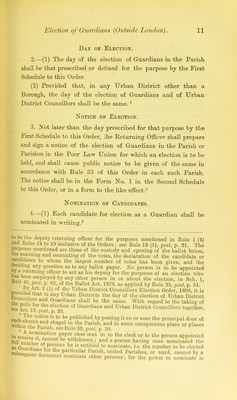
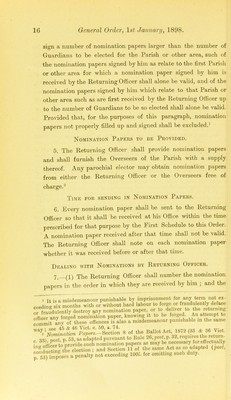
![the Form set out in the notice in the Form No. 1 in the Second Schedule to this Order, or in a form to the like effect.1 1 “ A person ceasing to hold the office of Guardian shall, unless disqualified “ to hold the office, be re-eligible,” see s. 37 of the Municipal Corporations Act, 1882 (45 & 46 Viet. c. 50, post, p. 67). Parochial electors are “ the persons “ registered in such portions either of the Local Government register of electors, “ or of the parliamentary register of electors as relates to the Parish.” [The Local Government Act, 1894, s. 2 (1).] The “ local government register ” is “ as “respects an administrative county in England or Wales, other than a county “borough, the county register, and as respects a county borough or other “ municipal borough, the burgess roll,” and the “ parliamentary register of “ electors ” is the “ register of persons entitled to vote at any parliamentary “ election.” (The Interpretation Act, 1889, 52 & 53 Viet. c. 63, s. 17.) Eor the persons entitled to be registered as local government or as parliamentary electors, see the note to s. 2 of the Local Government Act, 1894, in Jenkin’s Law relating to Parish Councils, second edition, pp. 4 and 5, published by Knight & Co. By Section 43 of the Local Government Act, 1894, it is enacted that for the purposes of the Act “ a woman shall not be disqualified by marriage for being “ on any local government register of electors, or for being an elector of any “ local authority, provided that a husband and wife shall not both be qualified “ in respect of the same property ; ” and by Section 44 (1) of the same Act it is enacted that “ any person whose name is not in that register,” i.e. the register of the parochial electors of the Parish, “ shall not be entitled to . . . vote as a “ parochial elector, and any person whose name is in that register shall be “entitled to . . . vote as a parochial elector unless prohibited from voting by “ this or any other Act of Parliament.” Sex affords no ground of disqualification for election as a Guardian; see section 20 (2) of the Local Government Act, 1894, ante, p. 12. A married woman who owns but does not occupy property in a Parish being, however, debarred by such want of occupancy from getting on the local government register; and being debarred by her sex from getting on the parliamentary register, cannot be placed on the register of parochial electors, Drax v. Ffooks, 74 L.T., n.s. 43, (1896); 1 Q. B., 238 ; 44 W.R., 393 ; 60 J.P., 214; 1 Smith, 40. An alien cannot be a Guardian of the poor, nor can he vote at an election of Guardians, inasmuch as Section 2 of the Naturalization Act, 1870 (33 & 34 Viet. c. 14), provides that the provisions of that Section shall not qualify an alien for any office, or for municipal, parliamentary, or other franchise, or entitle an alien to any right or privilege as a British subject, except as to property. Persons in receipt of relief, too, are prohibited from voting at elections of Guardians by 39 & 40 Viet. c. 61, s. 14, which enacts that: “ No person shall “ vote in such election who shall be in receipt of relief given to himself or his “ wife or child, or who shall have been in receipt of such relief on any day “ during the year last preceding such election.” A certificate from the Clerk to the Guardians is sufficient evidence of a person having received relief. Payment of elementary school fees for poor parents does not disqualify them from voting at an election of Guardians, 39 & 40 Viet. c. 79, s. 10. ... By the Bankruptcy Act, 1883 (46 & 47 Viet. c. 52), s. 32 a debtor who is ad- iudged a bankrupt is disqualified for being elected to or holding or exercising tie office of Guardian of the poor, unless the adjudication of bankruptcy is annulled or lie obtains from the court his discharge with a certificate to the effect that his bankruptcy was caused by misfortune without any misconduct on his par . I5y Section 34 of the Act, if a person is adjudged bankrupt whilst holding the office of Guardian, his office thereupon becomes vacant.](https://iiif.wellcomecollection.org/image/b28133158_0070.jp2/full/800%2C/0/default.jpg)


 No text description is available for this image
 No text description is available for this image
 No text description is available for this image