Licence: In copyright
Credit: The psychology of learning / by Edward L. Thorndike. Source: Wellcome Collection.
Provider: This material has been provided by The University of Leeds Library. The original may be consulted at The University of Leeds Library.
36/476 page 18
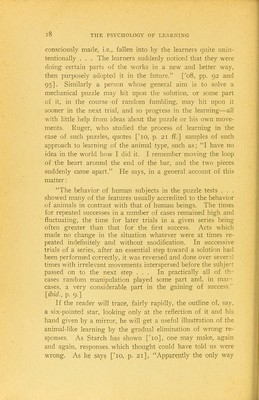
![consciously made, i.e., fallen into by the learners quite unin- tentionally . . . The learners suddenly noticed that they were doing certain parts of the works in a new and better way, then purposely adopted it in the future.” [’08, pp. 92 and 95]. Similarly a person whose general aim is to solve a mechanical puzzle may hit upon the solution, or some part of it, in the course of random fumbling, may hit upon it sooner in the next trial, and so progress in the learning—all with little help from ideas about the puzzle or his own move- ments. Ruger, who studied the process of learning in the case of such puzzles, quotes [To, p. 21 ff.] samples of such approach to learning of the animal type, such as; “I have no idea in the world how I did it. I remember moving the loop of the heart around the end of the bar, and the two pieces suddenly came apart.” He says, in a general account of this matter: “The behavior of human subjects in the puzzle tests . . . showed many of the features usually accredited to the behavior of animals in contrast with that of human beings. The times for repeated successes in a number of cases remained high and fluctuating, the time for later trials in a given series being often greater than that for the first success. Acts which made no change in the situation whatever were at times re- peated indefinitely and without modification. In successive trials of a series, after an essential step toward a solution had been performed correctly, it was reversed and done over sever'd times with irrelevant movements interspersed before the subject passed on to the next step ... In practically all of the cases random manipulation played some part and, in man' cases, a very considerable part in the gaining of success. [ibid., p. 9.] If the reader will trace, fairly rapidly, the outline of, say. a six-pointed star, looking only at the reflection of it and his hand given by a mirror, he will get a useful illustration of the animal-like learning by the gradual elimination of wrong re- sponses. As Starch has shown [To], one may make, again and again, responses, which thought could have told us were wrong. As he says [To, p. 21], “Apparently the only way](https://iiif.wellcomecollection.org/image/b2152421x_0036.jp2/full/800%2C/0/default.jpg)
 No text description is available for this image
 No text description is available for this image
 No text description is available for this image