Licence: In copyright
Credit: The psychology of learning / by Edward L. Thorndike. Source: Wellcome Collection.
Provider: This material has been provided by The University of Leeds Library. The original may be consulted at The University of Leeds Library.
42/476 page 24
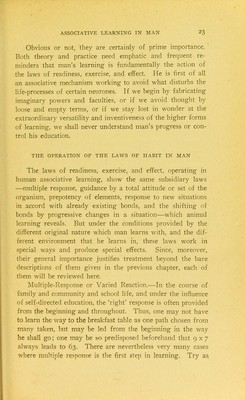
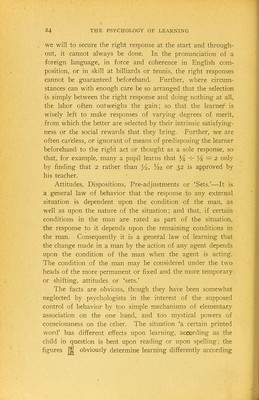
![24 THE PSYCHOLOGY OF LEARNING we will to secure the right response at the start and through- out, it cannot always be done. In the pronunciation of a foreign language, in force and coherence in English com- position, or in skill at billiards or tennis, the right responses cannot be guaranteed beforehand. Further, where circum- stances can with enough care be so arranged that the selection is simply between the right response and doing nothing at all, the labor often outweighs the gain; so that the learner is wisely left to make responses of varying degrees of merit, from which the better are selected by their intrinsic satisfying- ness or the social rewards that they bring. Further, we are often careless, or ignorant of means of predisposing the learner beforehand to the right act or thought as a sole response, so that, for example, many a pupil learns that % -f- ]/% = 2 only by finding that 2 rather than y2, %2 or 32 is approved by his teacher. Attitudes, Dispositions, Pre-adjustments or ‘Sets.’—It is a general law of behavior that the response to any external situation is dependent upon the condition of the man, as well as upon the nature of the situation; and that, if certain conditions in the man are rated as part of the situation, the response to it depends upon the remaining conditions in the man. Consequently it is a general law of learning that the change made in a man by the action of any agent depends upon the condition of the man when the agent is acting. The condition of the man may be considered under the two heads of the more permanent or fixed and the more temporary or shifting, attitudes or ‘sets.’ The facts are obvious, though they have been somewhat neglected by psychologists in the interest of the supposed control of behavior by too simple mechanisms of elementary association on the one hand, and too mystical powers of consciousness on the other. The situation ‘a certain printed word’ has different effects upon learning, according as the child in question is bent upon reading or upon spelling; the figures [I! obviously determine learning differently according](https://iiif.wellcomecollection.org/image/b2152421x_0042.jp2/full/800%2C/0/default.jpg)
 No text description is available for this image
 No text description is available for this image
 No text description is available for this image