Licence: In copyright
Credit: The psychology of learning / by Edward L. Thorndike. Source: Wellcome Collection.
Provider: This material has been provided by The University of Leeds Library. The original may be consulted at The University of Leeds Library.
448/476 page 430
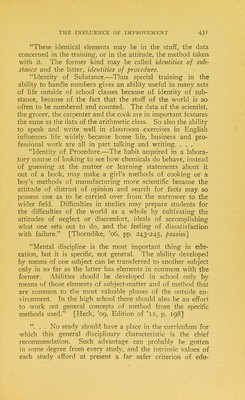
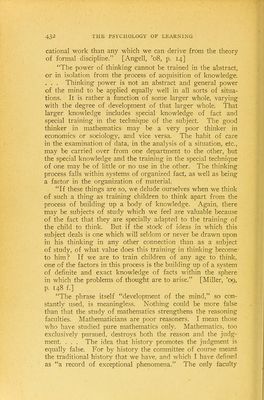
![not pause to discuss it. Certain it is that something of the sort occurs and that it is an acquirement which may pre- sumably be carried over from one type of occupation to another. If each form of effortful attention had a wholly unique type of discomfort attached to it, this inference might be challenged. But such does not seem to be the case.” [Angell, ’08, p. 9 f.] “Transfer of training is then possible in the ways indi- cated : (1) Where a single element to which a specific response is made functions under various environmental conditions because it is a common element in these various, and other- wise to a greater or less degree, dissimilar environments; (2) When a dominant mood or emotion so colors various environments that a characteristic response is obtained with- out identity of any one objective condition; (3) Where a single response in reality involves other and more general adjustments; (4) It is also possible, as Bagley suggests, through making the end of the activity a clearly conscious ideal. In this case the transfer takes place by a direct carry- ing over by consciousness not of the activity itself, but of the purpose of the activity, to another field.” [Colvin, ’09, edition of To, p. 30 f.] “My business is not to give a general mental training by means of my subject, for that is not possible, but to give a specific mental training such as my subject affords. . . . Especially, I must rely, not so much upon the generalized mental habits my subject is mistakenly supposed to form by its discipline as upon the conscious ideals of thought and conduct I am able to instill appropriately in relating my subject to life.” [Horne, ’09, p. 621] “One mental function or activity improves others in so far as and because they are in part identical with it, because it contains elements common to them. Addition improves multiplication because multiplication is largely addition; knowledge of Latin gives increased ability to learn French because many of the facts learned in the one case are needed in the other. The study of geometry may lead a pupil to be more logical in all respects, for one element of being logical in all respects is to realize that facts can be absolutely proven and to admire and desire this certain and unquestionable sort of demonstration. . . .](https://iiif.wellcomecollection.org/image/b2152421x_0448.jp2/full/800%2C/0/default.jpg)
 No text description is available for this image
 No text description is available for this image
 No text description is available for this image