Licence: In copyright
Credit: The psychology of learning / by Edward L. Thorndike. Source: Wellcome Collection.
Provider: This material has been provided by The University of Leeds Library. The original may be consulted at The University of Leeds Library.
450/476 page 432
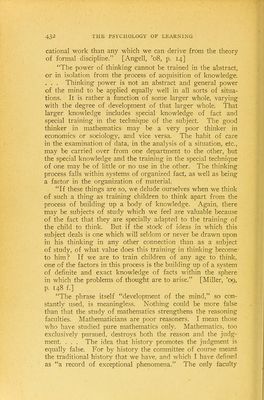
![cational work than any which we can derive from the theory of formal discipline.” [Angell, ’08, p. 14] “The power of thinking cannot be trained in the abstract, or in isolation from the process of acquisition of knowledge. . . . Thinking power is not an abstract and general power of the mind to be applied equally well in all sorts of situa- tions. It is rather a function of some larger whole, varying with the degree of development of that larger whole. That larger knowledge includes special knowledge of fact and special training in the technique of the subject. The good thinker in mathematics may be a very poor thinker in economics or sociology, and vice versa. The habit of care in the examination of data, in the analysis of a situation, etc., may be carried over from one department to the other, but the special knowledge and the training in the special technique of one may be of little or no use in the other. The thinking process falls within systems of organized fact, as well as being a factor in the organization of material. “If these things are so, we delude ourselves when we think of such a thing as training children to think apart from the process of building up a body of knowledge. Again, there may be subjects of study which we feel are valuable because of the fact that they are specially adapted to the training of the child to think. But if the stock of ideas in which this subject deals is one which will seldom or never be drawn upon in his thinking in any other connection than as a subject of study, of what value does this training in thinking become to him? If we are to train children of any age to think, one of the factors in this process is the building up of a system of definite and exact knowledge of facts within the sphere in which the problems of thought are to arise.” [Miller, ’09, p. 148 f.] “The phrase itself “development of the mind,” so con- stantly used, is meaningless. Nothing could be more false than that the study of mathematics strengthens the reasoning faculties. Mathematicians are poor reasoners. I mean those who have studied pure mathematics only. Mathematics, too exclusively pursued, destroys both the reason and the judg- ment. . . . The idea that history promotes the judgment is equally false. For by history the committee of course meant the traditional history that we have, and which I have defined as “a record of exceptional phenomena.” The only faculty](https://iiif.wellcomecollection.org/image/b2152421x_0450.jp2/full/800%2C/0/default.jpg)
 No text description is available for this image
 No text description is available for this image
 No text description is available for this image