Licence: In copyright
Credit: The psychology of learning / by Edward L. Thorndike. Source: Wellcome Collection.
Provider: This material has been provided by The University of Leeds Library. The original may be consulted at The University of Leeds Library.
56/476 page 38
![five pencils, and say, “See how many boys are standing up. Is Jack the only boy that is standing here? Are there more than two boys standing? Name the boys while I point at them and count them. (Jack) is one, and (Fred) is one more, and (Flenry) is one more. Jack and Fred make (two) boys. Jack and Fred and Henry make (three) boys.” (And so on with the attentive counting.) The mental set or attitude is directed toward favoring the partial and predominant ac- tivity of ‘how-many-ness’ as far as may be; and the useful bonds that the ‘fiveness,’ the ‘one and one and one and one and one-ness’'already have, are emphasized as far as may be. The second of the means used to facilitate analysis is having the learner respond to many situations each con- taining the element in question (call it A), but with varying concomitants (call these V.C.) his response being so directed as, so far as may be, to separate each total response into an element bound to the A and an element bound to the V.C* Thus the child is led to associate the responses—‘Five boys,’ ‘Five girls/ ‘Five pencils,’ ‘Five inches,’ ‘Five feet,’ ‘Five books,’ ‘He walked five steps,’ ‘I hit my desk five times,’ and the like—each with its appropriate situation. The ‘Five’ element of the response is thus bound over and over again to the ‘fiveness’ element of the situation, the mental set * Jam.es lists two conditions of the possibility of analyzing out an ele- ment in a situation for separate response to it. “If any single quality or constituent, a, have previously been known by us isolately, or have in any other manner already become an object of separate acquaintance” on our part . . . then that constituent a may be analysed out from the total im- pressions.'' [’93. Vol. I, p. 503] “What is associated noiu with one tlving and nozv rvith another tends to become disassociated from either.” [ibid., p. 506] The former case is, strictly, only one extreme limit of the latter, however. For no element really ever appears in complete isolation. Each is always a constituent of some total state of affairs The thunder clap, the light moving over a black background, and the like, which represent the nearest approaches to isolated appearance, are really parts of larger total situations and do have to be ‘dissociated’ by their varying concomi- tants. The difference is that the ‘dissociation’ or ‘abstraction’ occurs in such cases very, very easily. So it seems best to merge James’ first in his second condition.](https://iiif.wellcomecollection.org/image/b2152421x_0056.jp2/full/800%2C/0/default.jpg)
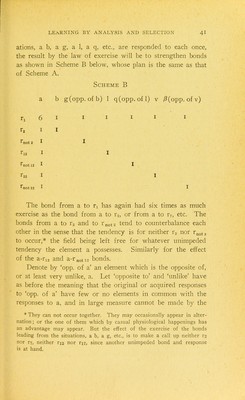
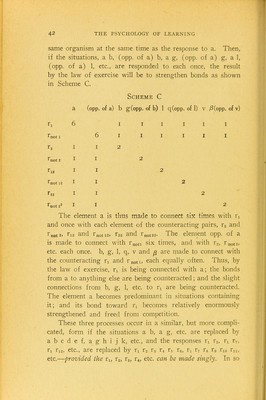
 No text description is available for this image
 No text description is available for this image
 No text description is available for this image