On the influence and use of the will in the treatment of many spinal deformities / by Dr. Roth.
- Mathias Roth
- Date:
- 1880
Licence: Public Domain Mark
Credit: On the influence and use of the will in the treatment of many spinal deformities / by Dr. Roth. Source: Wellcome Collection.
Provider: This material has been provided by The Royal College of Surgeons of England. The original may be consulted at The Royal College of Surgeons of England.
4/16 page 2
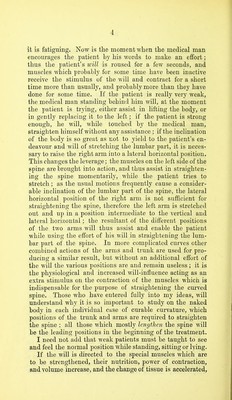
![this falling back from the normal into the abnormal posi- tion, all kinds of braces, spinal supports, corsets, ortho- pragms, stays and machines with and without vertical steel crutches resting on a horizontal band fixed on and round the legs, with the addition of steel plates pressing on the projecting parts, have been invented and unhappily arc still used, notwithstanding all the writings and the oppo- sition of those specialists who not only believe, but are convinced, that without removal of the cause no real cure can be permanently eft'ected. In this paper I intend to speak only of those forms of spinal curvatures where the patient himself can straighten the spine by his own will, or where he can do the same by placing the arms in different positions, or by placing the body as well as the arms in certain positions; and finally of those cases where the spine cannot be sti-aightened by the patient alone, but must be assisted by a second person. The majority of the patients being unconscious of their abnormal position, the first object to be obtained is to change the false mental impression they have in believing themselves straight when they are crooked, and feeling crooked when placed in a normal position. The second object is to enable the patients to retain the normal position which causes at first the sensation of being crooked. While the patient is reclining in a comfortable chair, which by the broad seat supports the full length of the thighs, and by the suitably curved back the spine of the patient, a looking-glass with a handle is placed before the patient to enable him to watch his own position. It happens that many patients cannot and do not alone observe that the head is either turned or bent to one side, or that it is both turned and bent; that one shoulder is higher or pro- jecting forward more than the other; that the trunk is more inclined to one side than to the other. If the same patient is placed in a standing position before a full length looking- glass, it also happens frequently that he cannot see the difference of form in the outline of his head, neck, shoulders, trunk, and knees. Where such a deficiency of sight and observing faculty exists, that the patient can neither feel his abnormal posi- tion nor see it in the looking-glass, he must be shown ]tow and to which side the head inclines or turns, or inclines and turns; the difi'erent height of both sides of the neck, and of both shoulders, the difference of the outlines from](https://iiif.wellcomecollection.org/image/b22277754_0006.jp2/full/800%2C/0/default.jpg)