Mollusca : testacellidæ and zonitidæ / by W.T. Blanford and H.H. Godwin-Austen.
- William Thomas Blanford
- Date:
- 1908
Licence: In copyright
Credit: Mollusca : testacellidæ and zonitidæ / by W.T. Blanford and H.H. Godwin-Austen. Source: Wellcome Collection.
319/352 (page 283)
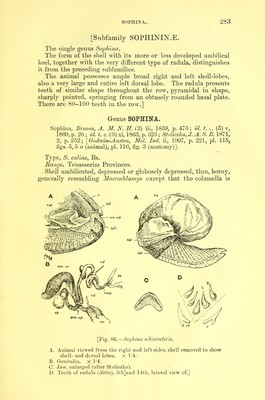
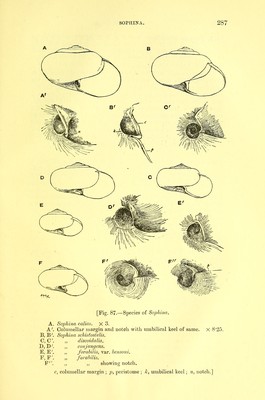
![[Subfamily SOPHININ^E. The single genus Sojphina. The form of the shell with its more or less developed umbilical keel, together with the very different type of radula, distinguishes it from the preceding subfamilies. The animal possesses ample broad right and left shell-lobes, also a very large and entire left dorsal lobe. The radula presents teeth of similar shape throughout the row, pyramidal in shape, sharply pointed, springing from an obtusely rounded basal plate. There are 80-100 teeth in the row.] Genus SOPHINA. Sophina, Benson, A. M. N. H. (3) iii, 1859, p. 473 ; id. t. (3) v, 1860, p. 26 ; id. t. c. (3) xi, 1863, p. 323 ; Stoliczka, J. A. S. B. 1871, 2, p. 252 j [Godivin-Austen, Mol. Ind. ii, 1907, p. 221, pi. 115, figs. 5, 5 a (animal), pi. 116, fig. 3 (anatomy)]. Type, S. ccdias, Bs. Range. Tenasserim Provinces. Shell umbilicated, depressed or globosely depressed, thin, horny, generally resembling MacrocJilamys except that the columella is [Fig. 86.—Sophina schistostelis. A. Animal viewed from the right and left sides, shell removed to show shell- and dorsal lobes. X 1'4. B. Genitalia. X 1*4. C. Jaw, enlarged (after Stoliczka). 13. Teeth of radula (ditto), 5tlrand 14th, lateral view of.]](https://iiif.wellcomecollection.org/image/b28076424_0319.jp2/full/800%2C/0/default.jpg)