Mollusca : testacellidæ and zonitidæ / by W.T. Blanford and H.H. Godwin-Austen.
- William Thomas Blanford
- Date:
- 1908
Licence: In copyright
Credit: Mollusca : testacellidæ and zonitidæ / by W.T. Blanford and H.H. Godwin-Austen. Source: Wellcome Collection.
325/352 (page 289)
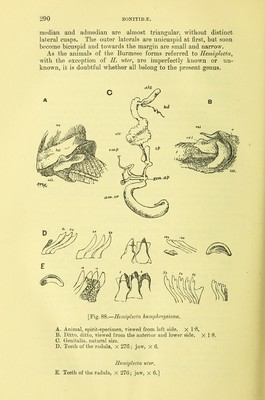
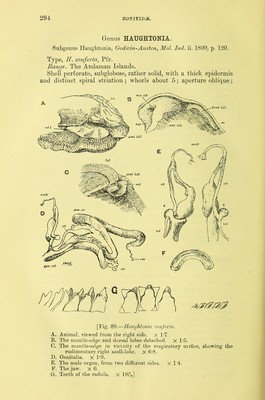
![or short close cleft forming a very sharp keel, continuous up the umbilicus. Size specimen figured: major diam. 8, min. 7*5, alt. 4 mm. Large spec, in Brit. Mus.: „ ,, 9, „ 8*5, „ 4 ,, Hab. Damotha, near Moulmein. Figured specimen from the Godwin-Austen collection : received from Stoliczka. This species may be known from all others of this genus by the coarse spiral striation on the basal side.] [458. Sophina forabilis, var. bensoni. Vide fig. 87, E, E'. Shell globosely conoid, umbilicated; surface smooth, not polished; colour umber-brown ; spire depressedly conoid, suture impressed ; whorls 5, increasing regularly, the last two rather more rapidly, rounded on the periphery; aperture ovately lunate, oblique, columellar margin subvertical, very slightly thickened, forming a sharp angle with the peristome, but no notch, the angle continued perspectively as a blunt keel within the umbilicus. Size: major diam. 7*5, min. 6-5, height axis 4 mm. Hab. Damotha, near Moulmein (Stoliczka). Three specimens of this shell received by me from Eerd. Stoliczka in the same tube with S. forabilis, but the absence of striation in the umbilical region and the different form of umbilical keel are sufficient to distinguish the species. It is very close to S. conjungens, but much smaller. Several examples named forabilis in the British Museum collection agree with this form.] Genus HEMIPLECTA. Ilemiplecta, Albers, Heliceen, 1850, p. 60; Godwin-Austen, Mol. Ind. ii, 1898, p. 70. Type, H. Humphrey siana, Lea, from Singapore. [Fig. 88, A-D.] Range. Burma, Siam, the Malay Peninsula and part of the Malay Archipelago. Species from the peninsula of India formerly referred to this genus are now known to belong to Arioplianta. Shell perforate or umbilicated, subterminate or depressed, rather solid; whorls regularly increasing; aperture lunate; peristome obtuse, sometimes more or less thickened. Animal with both right and left shell-lobes developed, but small; dorsal lobes large, the left divided into two parts. Mucous pore large, sometimes with an overhanging lobe above. Foot divided longitudinally beneath. In the generative organs the dart-sac is very large and cylin- drical, the spermatheca small and pear-shaped; the retracted muscle of the penis attached at about two-thirds of the length from the distal extremity to the junction of the vas deferens, without anv free caecum. No kalc-sac. Badula long and broad, with many teeth in a row. In II. Humphrey siana Godwin-Austen found 163 rows, each contain- ing 125 . 2 . 20 . 1 . 20 . 2 . 125 (147.1 . 147) teeth. The n](https://iiif.wellcomecollection.org/image/b28076424_0325.jp2/full/800%2C/0/default.jpg)