Mollusca : testacellidæ and zonitidæ / by W.T. Blanford and H.H. Godwin-Austen.
- William Thomas Blanford
- Date:
- 1908
Licence: In copyright
Credit: Mollusca : testacellidæ and zonitidæ / by W.T. Blanford and H.H. Godwin-Austen. Source: Wellcome Collection.
57/352 page 21
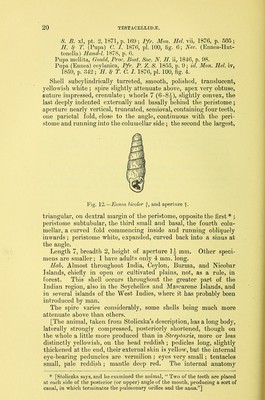
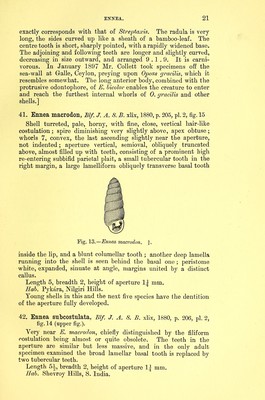
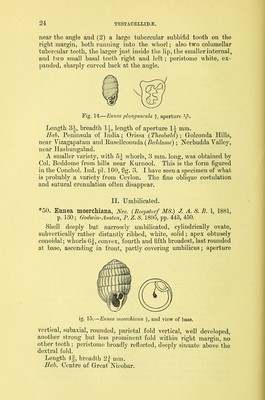
![exactly corresponds with that of Streptaxis. The radula is very long, the sides curved up like a sheath of a bamboo-leaf. The centre tooth is short, sharply pointed, with a rapidly widened base. The adjoining and following teeth are longer and slightly curved, decreasing in size outward, and arranged 9.1.9. It is carni- vorous. In January 1897 Mr. Collett took specimens off the sea-wall at Gralle, Ceylon, preying upon Ojpeas gracilis, which it resembles somewhat. The long anterior body, combined with the protrusive odontophore, of E. bicolor enables the creature to enter and reach the furthest internal whorls of 0. gracilis and other shells.] 41. Ennea macrodon, Blf. J. A. S. B. xlix, 1880, p. 205, pi. 2, fig. 15 Shell turreted, pale, horny, with fine, close, vertical hair-like costulation; spire diminishing very slightly above, apex obtuse; whorls 7, convex, the last ascending slightly near the aperture, not indented; aperture vertical, semioval, obliquely truncated above, almost filled up with teeth, consisting of a prominent high re-entering subbifid parietal plait, a small tubercular tooth in the right margin, a large lamelliform obliquely transverse basal tooth Fig. 13.—Ennea macrodon. inside the lip, and a blunt eolumellar tooth ; another deep lamella running into the shell is seen behind the basal one; peristome white, expanded, sinuate at angle, margins united by a distinct callus. Length 5, breadth 2, height of aperture 1| mm. Hab. Pykara, Nilgiri Hills. Young shells in this and the next five species have the dentition of the aperture fully developed. 42. Ennea subcostulata, Blf. J. A. S. B. xlix, 1880, p. 206, pi. 2, fig. 14 (upper fig.). Very near E. macroclon, chiefly distinguished by the filiform costulation being almost or quite obsolete. The teeth in the aperture are similar but less massive, and in the only adult specimen examined the broad lamellar basal tooth is replaced by two tubercular teeth. Length 5i breadth 2, height of aperture 11 mm. Hab. Shevroy Hills, S. India.](https://iiif.wellcomecollection.org/image/b28076424_0057.jp2/full/800%2C/0/default.jpg)



 No text description is available for this image
 No text description is available for this image
 No text description is available for this image