The specificity of serological reactions / [Karl Landsteiner].
- Karl Landsteiner
- Date:
- 1936
Licence: In copyright
Credit: The specificity of serological reactions / [Karl Landsteiner]. Source: Wellcome Collection.
22/196 page 10
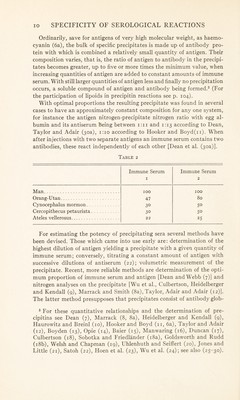
![Ordinarily, save for antigens of very high molecular weight, as haemo- cyanin (6a), the bulk of specific precipitates is made up of antibody pro- tein with which is combined a relatively small quantity of antigen. Their composition varies, that is, the ratio of antigen to antibody in the precipi- tates becomes greater, up to five or more times the minimum value, when increasing quantities of antigen are added to constant amounts of immune serum. With still larger quantities of antigen less and finally no precipitation occurs, a soluble compound of antigen and antibody being formed.3 (For the participation of lipoids in precipitin reactions see p. 104). With optimal proportions the resulting precipitate was found in several cases to have an approximately constant composition for any one system, for instance the antigen nitrogen-precipitate nitrogen ratio with egg al- bumin and its antiserum being between 1:11 and 1:13 according to Dean, Taylor and Adair (30a), 1:10 according to Hooker and Boyd(n). When after injections with two separate antigens an immune serum contains two antibodies, these react independently of each other [Dean et al. (30a)]. Table 2 Immune Serum 1 Immune Serum 2 Man 100 100 Orang-Utan 47 80 Cynocephalus mormon 30 50 Cercopithecus petaurista 30 50 Ateles vellerosus 22 25 For estimating the potency of precipitating sera several methods have been devised. Those which came into use early are: determination of the highest dilution of antigen yielding a precipitate with a given quantity of immune serum; conversely, titrating a constant amount of antigen with successive dilutions of antiserum (22); volumetric measurement of the precipitate. Recent, more reliable methods are determination of the opti- mum proportion of immune serum and antigen [Dean and Webb (7)] and nitrogen analyses on the precipitate [Wu et al., Culbertson, Heidelberger and Kendall (9), Marrack and Smith (8a), Taylor, Adair and Adair (12)]. The latter method presupposes that precipitates consist of antibody glob- 3 For these quantitative relationships and the determination of pre- cipitins see Dean (7), Marrack (8, 8a), Heidelberger and Kendall (9), Haurowitz and Breinl (10), Hooker and Boyd (11, 6a), Taylor and Adair (12), Boyden (13), Opie (14), Baier (15), Manwaring (16), Duncan (17), Culbertson (18), Sobotka and Friedlander (18a), Goldsworth and Rudd (18b), Welsh and Chapman (19), Uhlenhuth and Seiffert (20), Jones and](https://iiif.wellcomecollection.org/image/b29808807_0024.jp2/full/800%2C/0/default.jpg)


 No text description is available for this image
 No text description is available for this image
 No text description is available for this image