Demographic genetics / edited by Kenneth M. Weiss and Paul A. Ballonoff.
- Date:
- [1975]
Licence: Attribution-NonCommercial-NoDerivatives 4.0 International (CC BY-NC-ND 4.0)
Credit: Demographic genetics / edited by Kenneth M. Weiss and Paul A. Ballonoff. Source: Wellcome Collection.
132/440 page 112
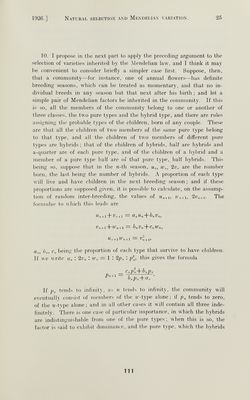
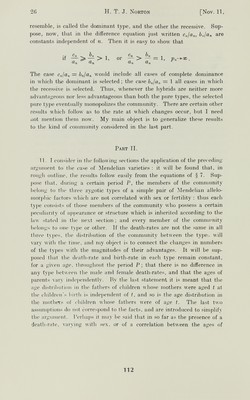
![2G H. T. J. Norton [Nov. 11, resemble, is called the dominant type, and the other the recessive. Sup¬ pose, now, that in the difference equation just written c„/a„, ò„/a„ are constants independent of n. Then it is easy to show that ^71 ^11 1 if > — >1, or — > — =1, p,r^<x>. an an an an ^ The case cjan = bjan would include all cases of complete dominance in which thß dominant is selected ; the case ¿)„/a„ = 1 all cases in which the recessive is selected. Thus, whenever the hybrids are neither more advantageous nor less advantageous than both the pure types, the selected pure type eventually monopolizes the community. There are certain other results which follow as to the rate at which changes occur, but I need not mention them now. My main object is to generalize these results to the kind of community considered in the last part. Part II. n. T consider in the following sections the application of the preceding argument to the case of Mendelian varieties : it will be found that, in rough outline, the results follow easily from the equations of § 7. Sup¬ pose that, during a certain period P, the members of the comnumity belong to the three zygotic types of a simple pair of ]\Iendelian allelo- mor{)]iic factors which are not correlated with sex or fertility : thus each type consists of those members of the community who possess a certain peculiarity of appearance or structure which is inherited according to the law stated in the next section ; and every member of the comnumity belongs to one type or other. If the death-rates are not the same in all three types, the distribution of the community between the type:, will vary with the time, and my object is to connect the changes in numbers of the types with the magnitudes of their advantages. It will be sup¬ posed that the death-rate and birth-rate in each type remain constant, for a given age, throughout the period P; that there is no difference in any type between the male and female death-rates, and that the ages of parents vary independently. By the la.st statement it is meant that the age distril)uti()n in the fathers of children whose mothers were aged t at the children's i)irtii is independent of t, and so is the age distribution in the mothers of children whose fathers were of age t. The last two assumptions do not correspond to the facts, and are introduced to simplify the argument. Perhaps it may be said that in so far as the presence of a death-rate, varying with sex, or of a correlation between the ages of 112](https://iiif.wellcomecollection.org/image/b18037239_0133.JP2/full/800%2C/0/default.jpg)
 No text description is available for this image
 No text description is available for this image
 No text description is available for this image