Harvey and his claims as a discoverer : a lecture, delivered at Folkestone on the three-hundredth anniversary of his birth (April 1st, 1578) / by Robert C. Jenkins.
- Robert Charles Jenkins
- Date:
- 1878
Licence: Public Domain Mark
Credit: Harvey and his claims as a discoverer : a lecture, delivered at Folkestone on the three-hundredth anniversary of his birth (April 1st, 1578) / by Robert C. Jenkins. Source: Wellcome Collection.
Provider: This material has been provided by The Royal College of Surgeons of England. The original may be consulted at The Royal College of Surgeons of England.
9/24 page 9
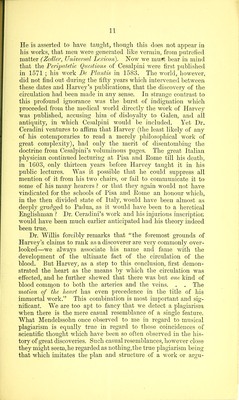
![Harvey, Avliile the personal means of resistance were so much less. This consideration we must take into account in our estimation of the originality of his work and the irrefragability of his claims. It might seem almost a work of supererogation, in the face of the testimony we are a])le to produce from tlie ti'eatise of Harvey himself, to trace the long succession of great men, wlio, not in their own person, but by their posthumous advocates, have put in a claim to the anticipation at least of tlie icUa of the circulation of the blood. From Plato to St. Gregory of Nyssa in the fourth century, from the natural Theology of Theodorit* in the fifth century to the scholastic divinity of Aquinas in the thirteenth, one writer after another repeats in weary monotony a more or less distinct prophecy of a kind of blood-circulation, not in the modern and true sense, but in tliat of a kind of flux and reflux of the blood—an ebb and flow resembling rather a contrary than a circular motion. As we pass on through the darkness of the middle ages to the period of the establishment of inductive reasoning in the sixteenth century we continually seem to be approaching the light, and again to be lost in darkness. Every one who is summoned as a witness or rival in this great controversy will be found (and I venture to say, has been proved) merely to have suggested a pathway out of the gloom which the processes of inductive reasoning and experimental investigation alone could lay down with clearness on the map of (what I may term) physical geography. Before the introduction of this method the prob- lem might indeed have been hinted at, or stated, wuth more or less accuracy, but the solution of it was simply impossible. The tract of Aquinas On the Motion of the Heart, written in 1270, presents what we might call a ''guessing at the truth”, which though very obscure is very curious. From the dilatation and contraction of the heart he derives a kind of circular motion, only interrupted by a short interval which corresponds with what Harvey calls the period of rest; “Hahet quondam rwtum circularcm” are his words—a motion wfliich he attributes to the heating of the blood around the heart. He does not deal in vital spirits’’ or admit the favourite comparison to the growth of a plant, but he fails to connect his circular motion’’ with its true cause, or to take up the second of the subjects which Harvey has wedded together in his immortal treatise. The great Italian Keformer Zanchius, seems to make a still nearer approach to the truth, deriving his anatomical knowledge as he tells us from Vesalius and Melanc- * Senii()ucf< dt Providcntid,](https://iiif.wellcomecollection.org/image/b22465522_0013.jp2/full/800%2C/0/default.jpg)

 No text description is available for this image
 No text description is available for this image
 No text description is available for this image