The biology of death : being a series of lectures delivered at the Lowell Institute in Boston in December 1920 / by Raymond Pearl.
- Raymond Pearl
- Date:
- [1922], ©1922
Licence: Public Domain Mark
Credit: The biology of death : being a series of lectures delivered at the Lowell Institute in Boston in December 1920 / by Raymond Pearl. Source: Wellcome Collection.
111/292 (page 99)
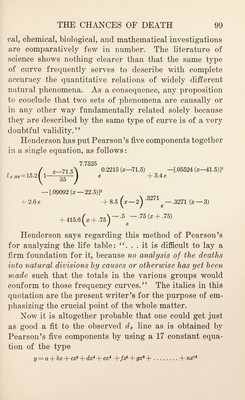
![cal, chemical, biological, and mathematical investigations are comparatively few in number. The literature! of science shows nothing clearer than that the same type of curve frequently serves to describe with complete accuracy the quantitative relations of widely different natural phenomena. As a consequence, any proposition to conclude that two sets of phenomena are causally or in any other way fundamentally related solely because they are described by the same type of curve is of a very doubtful validity. ’ ’ Henderson has put Pearson’s five components together in a single equation, as follows: 7.7525 0.2215 (z—71.5) —[.05524 —41.5)]2 e + 5.4 e —• [.09092 (x — 22.5)]2 4- 2.6 e + 8.5 (x — 2^ 3271 g — .3271 {x — 3) + 415.6 (* + .75)'-^-.75(z + .75) Henderson says regarding this method of Pearson’s for analyzing the life table: . . it is difficult to lay a firm foundation for it, because no analysis of the deaths into natural divisions by causes or otherwise has yet been made such that the totals in the various groups would conform to those frequency curves.” The italics in this quotation are the present writer’s for the purpose of em¬ phasizing the crucial point of the whole matter. Now it is altogether probable that one could get just as good a fit to the observed dx line as is obtained by Pearson’s five components by using a 17 constant equa¬ tion of the type y = a bx -f- cx2 + dx3 -f- ex4 +/x6 4- gx6 +.4- nx16 l x Mx—15 2( x—71.5 35](https://iiif.wellcomecollection.org/image/b29819465_0111.jp2/full/800%2C/0/default.jpg)