A dictionary of classical antiquities : mythology, religion, literature & art / from the German of Dr. Oskar Seyffert ; revised and edited with additions, by Henry Nettleship, J.E. Sandys ; with more than 450 illustrations.
- Oskar Seyffert
- Date:
- 1901
Licence: Public Domain Mark
Credit: A dictionary of classical antiquities : mythology, religion, literature & art / from the German of Dr. Oskar Seyffert ; revised and edited with additions, by Henry Nettleship, J.E. Sandys ; with more than 450 illustrations. Source: Wellcome Collection.
712/732 (page 700)
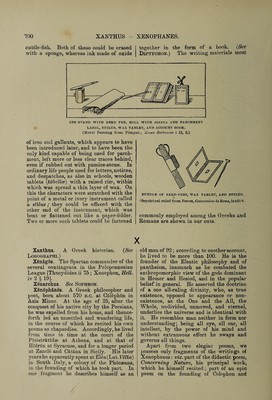
![cuttle-fish. Both of these could be erased with a sponge, whereas ink made of oxide together in the form of a book. (See Diptychon.) The writing materials most INK-STAND WITH REED PEN, ROLL WITH CORNUA AND PARCHMENT LABEL, STILUS, WAX TABLET, AND ACCOUNT BOOK. (Mural Painting from Pompeii; IIuaeo Borbonioo i 12, 2.) of iron and gallnuts, which appears to have been introduced later, and to have been the only kind capable of being used for parch¬ ment, left more or less clear traces behind, even if rubbed out with pumice-stone. In ordinary life people used for letters, notices, and despatches, as also in schools, wooden tablets (tabellce) with a raised rim, within which was spread a thin layer of wax. On this the characters were scratched with the point of a metal or ivory instrument called a stilus; they could be effaced with the other end of the instrument, which was bent or flattened out like a paper-folder. Two or more such tablets could be fastened BUNDLE OF REED-PENS, WAX TABLET, AND STILUS. (Sepulchral relief from Perret, Catacomb es deRome, lxxiii 6. commonly employed among the Greeks and Romans are shown in our cuts. X Xanthus. A Greek historian. (See Logographi.) Xenagos. The Spartan commander of the several contingents in the Peloponnesian League [Thucydides ii 75; Xenophon, Hell. iv 2 § 19]. Xenarchus. See Sophron. Xenophanes. A Greek philosopher and poet, born about 570 b.c. at Colophon in Asia Minor. At the age of 25, after the conquest of his native city by the Persians, he was expelled from his home, and thence¬ forth led an unsettled and wandering life, in the course of which he recited his own poems as rhapsodies. Accordingly, he lived from time to time at the court of the Plsistratidse at Athens, and at that of Hieron at Syracuse, and for a longer period at Zancle and Catana in Sicily. His later years he apparently spent at Elea(Lat.FeZia) in South Italy, a colony of the Phocseans, in the founding of which he took part. In one fragment he describes himself as an old man of 92; according to another account, he lived to be more than 100. He is the founder of the Eleatic philosophy and of pantheism, inasmuch as he combated the anthropomorphic view of the gods dominant in Homer and Hesiod, and in the popular belief in general. He asserted the doctrine of a one all-ruling divinity, who, as true existence, opposed to appearance or non¬ existence, as the One and the All, the Whole, undivided, unmoved, and eternal, underlies the universe and is identical with it. He resembles man neither in form nor understanding; being all eye, all ear, all intellect, by the power of his mind and without extraneous effort he sways and governs all things. Apart from two elegiac poems, we possess only fragments of the writings of Xenophanes: viz. part of the didactic poem, Concerning Nature, his principal work, which he himself recited; part of an epic poem on the founding of Colophon and](https://iiif.wellcomecollection.org/image/b3135841x_0712.jp2/full/800%2C/0/default.jpg)