Sixth report from the Select Committee on Estimates : together with the minutes of evidence taken before sub-committee D and appendices, session 1956-1957: Running costs of hospitals.
- Great Britain. Parliament. House of Commons. Select Committee on Estimates
- Date:
- [1957]
Licence: Public Domain Mark
Credit: Sixth report from the Select Committee on Estimates : together with the minutes of evidence taken before sub-committee D and appendices, session 1956-1957: Running costs of hospitals. Source: Wellcome Collection.
118/448 page 96
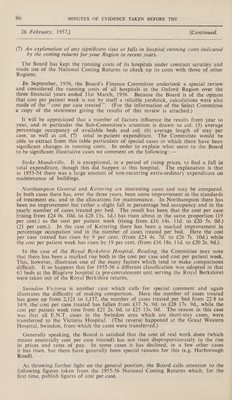
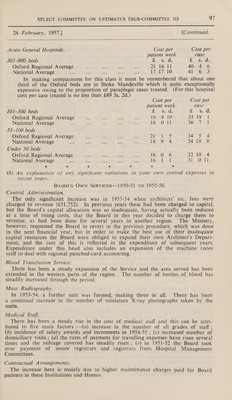
![26 February, 1957.] [Continued. ee — ee eeeeeeeeeeeeEeeeEeeeeeeeeeeeeeeeeeeEeEeeeeeEEEeEEeEeeEesSsSs (7) An explanation of any significant rises or falls in hospital running costs indicated by the costing returns for your Region in recent years. The Board has kept the running costs of its hospitals under constant scrutiny and Slee use of the National Costing Returns to check up its costs with those of other egions. In September, 1956, the Board’s Finance Committee undertook a special review and considered the running costs of all hospitals in the Oxford Region over the three financial years ended 31st March, 1956. Because the Board is of the opinon that cost per patient week is not by itself a reliable yardstick, calculations were also made of the “cost per case treated”. (For the information of the Select Committee a copy of the statement giving the results of this review is attached.) It will be appreciated that a number of factors influence the results from year to year, and in particular the Sub-Committee’s attention is drawn to col. (3) average percentage occupancy of available beds and col. (6) average length of stay per case, as well as col. (7) total in-patient expenditure. The Committee would be able to extract from this table particulars of special cases in which there have been significant changes in running costs. In order to explain what seem to the Board to be significant illustrative cases we comment on the following : — Stoke Mandeville. It is exceptional, in a period of rising prices, to find a fall in total expenditure, though this did happen at this hospital. The explanation is that in 1953-54 there was a large amount of non-recurring extra-ordinary expenditure on maintenance of buildings. Northampton General and Kettering are interesting cases and may be compared. In both cases there has, over the three years, been some improvement in the standards of treatment etc. and in the allocations for maintenance. In Northampton there has been no improvement but rather a slight fall in percentage bed occupancy and in the yearly number of cases treated per bed. The result has been that the cost per case (rising from £24 Os. 10d. to £28 13s. 1d.) has risen about in the same proportion (19 per cent.) as the cost per patient week (rising from £16 14s. Ild. to £20 5s. 0d.) (21 per cent.). In the case of Kettering there has been a marked improvement in percentage occupation and in the number of cases treated per bed. Here the cost per case treated has risen by 9 per cent. (from £24 4s. 7d. to £26 7s. 10d.) while the cost per patient week has risen by 19 per cent. (from £16 18s. 11d. to £20 2s. 9d.). In the case of the Royal Berkshire Hospital, Reading, the Committee may note that there has been a marked rise both in the cost per case and cost per patient week. This, however, illustrates one of the many factors which tend to make comparisons difficult. It so happens that for 1955-56 a different classification was adopted in that 65 beds at the Blagrave hospital (a pre-convalescent unit serving the Royal Berkshire) were taken out of the Royal Berkshire returns. Swindon Victoria is another case which calls for special comment and again illustrates the difficulty of making comparison. Here the number of cases treated has gone up from 2,121 to 3,137, the number of cases treated per bed from 22°8 to 34:9, the’ cost per case treated has fallen from £37 5s. 9d. to £28 17s. 9d., while the cost per patient week rose from £21 2s. Od. to £25 13s. Od. The reason in this case was that all E.N.T. cases in the Swindon area which are short-stay cases, were transferred to the Victoria Hospital. (The reverse happened at the Great Western Hospital, Swindon, from which the cases were transferred.) Generally speaking, the Board is satisfied that the cost of real work done (which means essentially cost per case treated) has not risen disproportionately to the rise in prices and rates of pay. In some cases it has declined, in a few other cases it has risen, but there have generally been special reasons for this (e.g. Harborough Road). | As throwing further light on the general position, the Board calls attention to the following figures taken from the 1955-56 National Costing Returns which, for the first time, publish figures of cost per case. .](https://iiif.wellcomecollection.org/image/b32182466_0118.jp2/full/800%2C/0/default.jpg)
 No text description is available for this image
 No text description is available for this image
 No text description is available for this image