Sixth report from the Select Committee on Estimates : together with the minutes of evidence taken before sub-committee D and appendices, session 1956-1957: Running costs of hospitals.
- Great Britain. Parliament. House of Commons. Select Committee on Estimates
- Date:
- [1957]
Licence: Public Domain Mark
Credit: Sixth report from the Select Committee on Estimates : together with the minutes of evidence taken before sub-committee D and appendices, session 1956-1957: Running costs of hospitals. Source: Wellcome Collection.
120/448 page 98
![26 February, 1957.] [Continued. (9), The current operation of the service—efficiency and economy. We note the following headings, which we could develop in oral evidence. Efficiency and economy have been our constant study. In the nature of the case we have concentrated chiefly on producing better results and fuller services from the sums of money allotted to us. This has been our obvious need, because there have been so many shortcomings to make good (long waiting lists to be reduced, better distribution of consultant services to be achieved, improvement in conditions, especially in our mental hospitals, etc., etc.). (i) Efficiency and economy depend on the quality and effort of the human beings employed in the service at all levels down to the very bottom. We need better quality at many levels. Therefore we attach great importance to creating a better career structure for hospital administrative staff and better rates of pay for key posts. (Refer to the Guillebaud Committee recommendations.) (ii) Economy and efficiency depend upon everybody being cost-conscious. We need to spread this cost-consciousness to all ranks, to matrons and nursing staff as well as administrative officers. This means that they ought (a) to understand and be interested in the financial position ; (b) to feel that they have some responsibility for it; (c) to feel that if they can save money they will get some benefit from it by being able to devote savings to very necessary improvements. For this reason we believe in stimulating joint consultation, and in giving responsibility to House Committees, letting them know their budgets, etc., etc. (iii) One of the most important concrete possibilities would be to save running expenses by better capital equipment (engineering installations, kitchen equipment and design, labour-saving equipment of all kinds). Many of our buildings are most uneconomical to run, though it may perhaps be too much to expect capital to rebuild; but shortage of capital has been a great handicap to increasing efficiency and economy. (iv) Some economies should be possible by greater standardisation of different kinds of equipment (domestic textiles, crockery, hardware, etc.). Standardi- sation, making it possible to place bulk orders—e.g. to give long runs to textile manufacturers—needs to be handled on a national basis. There is still room for the ‘Ministry to give a constructive lead here, though we recognise they have difficulties in combatting the individualism of different hospital authorities. (v) In other ways the Ministry might give more helpful guidance. Compare what the Ministry of Education with its building section has been able to do—to reduce the cost of school building. (vi) In many cases greater efficiency and economy could be achieved if we were allowed to pay more so as to attract first class personnel, such as catering officers, etc. (vii) In order to keep check on our Hospital Management Committees we need much more accurate knowledge of what a given service ought to cost if efficiently run. A very great need is to develop knowledge in this field by better cost accounting, etc. (viii) We believe that, although conditions for running an industry are quite different from running the hospital service, nevertheless there should be much to be learned from the greatly improving industrial techniques which have been developed during the last ten years. We have been in touch with the Work Study Department of Imperial Chemical Industries and we have plans for a pioneer project for exploring the possibilities under this head. In considering the current operation of the service and a Regional Board’s powers to achieve economies and efficiency, it is important to understand the scope of a Board’s authority. The general tendency of policy in the first years of the service was to limit this scope. The Ministry made it very clear that they retained the power to deal direct](https://iiif.wellcomecollection.org/image/b32182466_0120.jp2/full/800%2C/0/default.jpg)
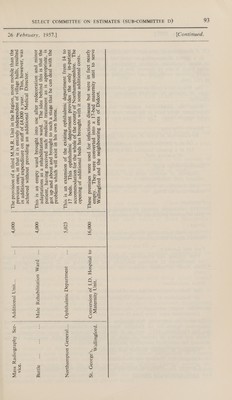
 No text description is available for this image
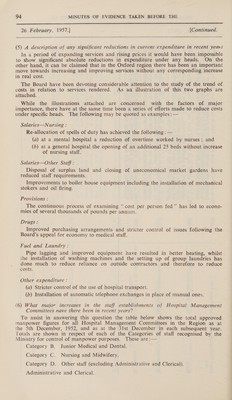
 No text description is available for this image
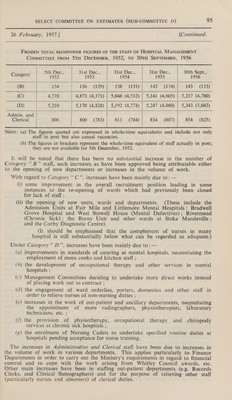
 No text description is available for this image