Sixth report from the Select Committee on Estimates : together with the minutes of evidence taken before sub-committee D and appendices, session 1956-1957: Running costs of hospitals.
- Great Britain. Parliament. House of Commons. Select Committee on Estimates
- Date:
- [1957]
Licence: Public Domain Mark
Credit: Sixth report from the Select Committee on Estimates : together with the minutes of evidence taken before sub-committee D and appendices, session 1956-1957: Running costs of hospitals. Source: Wellcome Collection.
29/448 page 7
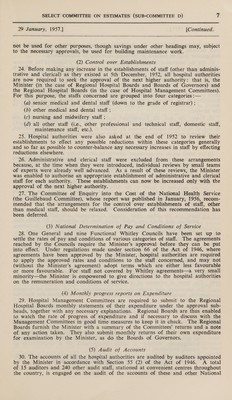
![29 January, 1957.] [Continued. not be used for other purposes, though savings under other headings may, subject to the necessary approvals, be used for building maintenance work. (2) Control over Establishments 24. Before making any increase in the establishments of staff (other than adminis- trative and clerical) as they existed at Sth December, 1952, all hospital authorities are now required to seek the approval of the next higher authority: that is, the Minister (in the case of Regional Hospital Boards and Boards of Governors) and the Regional Hospital Boards (in the case of Hospital Management Committees). For this purpose, the staffs concerned are grouped into four categories :— (a) senior medical and dental staff (down to the grade of registrar) ; (b) other medical and dental staff ; (c) nursing and midwifery staff ; (d) all other staff (i.e., other professional and technical staff, domestic staff, maintenance staff, etc.). 25. Hospital authorities were also asked at the end of 1952 to review their establishments to effect any possible reductions within these categories generally and so far as possible to counter-balance any necessary increases in staff by effecting reductions elsewhere. 26. Administrative and clerical staff were excluded from these arrangements because, at the time when they were introduced, individual reviews by small teams of experts were already well advanced. As a result of these reviews, the Minister was enabled to authorise an appropriate establishment of administrative and clerical staff for each authority. These establishments can now be increased only with the approval of the next higher authority. 27. The Committee of Enquiry into the Cost of the National Health Service (the Guillebaud Committee), whose report was published in January, 1956, recom- mended that the arrangements for the control over establishments of staff, other than medical staff, should be relaxed. Consideration of this recommendation has been deferred. (3) National Determination of Pay and Conditions of Service 28. One General and nine Functional Whitley Councils have been set up to settle the rates of pay and conditions of various categories of staff. The agreements reached by the Councils require the Minister’s approval before they can be put into effect. Under regulations made under section 66 of the Act of 1946, where agreements have been approved by the Minister, hospital authorities are required to apply the approved rates and conditions to the staff concerned, and may not (without the Minister’s agreement) adopt terms which are either less favourable or more favourable. For staff not covered by Whitley agreements—a very small minority—the Minister is empowered to give directions to the hospital authorities on the remuneration and conditions of service. (4) Monthly progress reports on Expenditure 29. Hospital Management Committees are required to submit to the Regional Hospital Boards monthly statements of their expenditure under the approval sub- heads, together with any necessary explanations. Regional Boards are thus enabled to watch the rate of progress of expenditure and if necessary to discuss with the Management Committees in good time measures to keep it in check. The Regional Boards furnish the Minister with a summary of the Committees’ returns and a note of any action taken. They also submit monthly returns of their own expenditure for examination by the Minister, as do the Boards of Governors. (5) Audit of Accounts 30. The accounts of all the hospital authorities are audited by auditors appointed by the Minister in accordance with Section 55 (2) of the Act of 1946. A total of 15 auditors and 240 other audit staff, stationed at convenient centres throughout the country, is engaged on the audit of the accounts of these and other National](https://iiif.wellcomecollection.org/image/b32182466_0029.jp2/full/800%2C/0/default.jpg)
 No text description is available for this image
 No text description is available for this image
 No text description is available for this image