A report on the collection and use of information about hospital clinical activity in the National Health Service / Steering Group on Health Services Information ; chairman, E. Körner.
- Great Britain. Department of Health and Social Security. Steering Group on Health Services Information
- Date:
- 1982
Licence: Open Government Licence
Credit: A report on the collection and use of information about hospital clinical activity in the National Health Service / Steering Group on Health Services Information ; chairman, E. Körner. Source: Wellcome Collection.
21/150 page 17
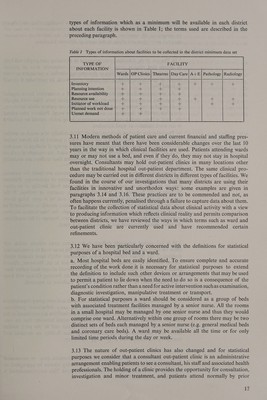
![types of information which as a minimum will be available in each district about each facility is shown in Table I; the terms used are described in the preceding paragraph. Table I Types of information about facilities to be collected in the district minimum data set TYPE OF FACILITY INKORIMAT ON ———— Wards | OP Clinics Day Care| A+ E] Pathology | Radiology Theatres Inventory Planning intention Resource availability Resource use Initiator of workload Planned work not done Unmet demand ++4++4+4+ 3.11 Modern methods of patient care and current financial and staffing pres- sures have meant that there have been considerable changes over the last 10 years in the way in which clinical facilities are used. Patients attending wards may or may not use a bed, and even if they do, they may not stay in hospital overnight. Consultants may hold out-patient clinics in many locations other than the traditional hospital out-patient department. The same clinical pro- cedure may be carried out in different districts in different types of facilities. We found in the course of our investigations that many districts are using their facilities in innovative and unorthodox ways: some examples are given in paragraphs 3.14 and 3.16. These practices are to be commended and not, as often happens currently, penalised through a failure to capture data about them. To facilitate the collection of statistical data about clinical activity with a view to producing information which reflects clinical reality and permits comparison between districts, we have reviewed the ways in which terms such as ward and out-patient clinic are currently used and have recommended certain refinements. 3.12 We have been particularly concerned with the definitions for statistical purposes of a hospital bed and a ward. a. Most hospital beds are easily identified. To ensure complete and accurate recording of the work done it is necessary for statistical purposes to extend the definition to include such other devices or arrangements that may be used to permit a patient to lie down when the need to do so is a consequence of the patient’s condition rather than a need for active intervention suchas examination, diagnostic investigation, manipulative treatment or transport. b. For statistical purposes a ward should be considered as a group of beds with associated treatment facilities managed by a senior nurse. All the rooms in a small hospital may be managed by one senior nurse and thus they would comprise one ward. Alternatively within one group of rooms there may be two distinct sets of beds each managed by a senior nurse (e.g. general medical beds and coronary care beds). A ward may be available all the time or for only limited time periods during the day or week. 3.13 The nature of out-patient clinics has also changed and for statistical purposes we consider that a consultant out-patient clinic is an administrative arrangement enabling patients to see a consultant, his staff and associated health professionals. The holding of a clinic provides the opportunity for consultation, investigation and minor treatment, and patients attend normally by prior ki](https://iiif.wellcomecollection.org/image/b32220182_0021.jp2/full/800%2C/0/default.jpg)